Guides
What Is Saponification? How Oil and Lye Become Soap
By The Soap Brain Team — Cold-process soap makers & formulators
·
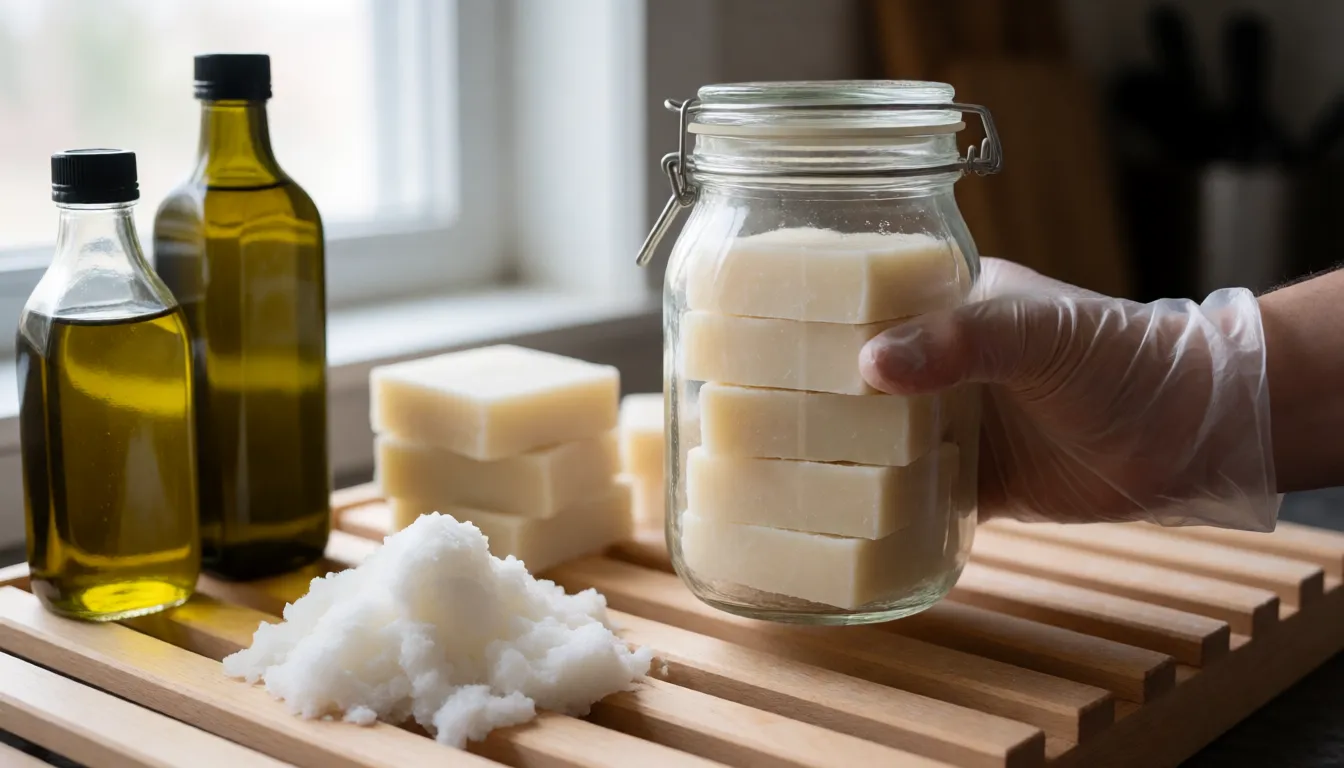
Saponification is the reaction of a fat or oil (a triglyceride) with a strong base. Sodium hydroxide (NaOH, lye) gives bar soap, and potassium hydroxide (KOH) gives liquid soap. The products are soap, which is a salt of fatty acids, and glycerol. The word comes from sapo, Latin for soap, so it means "turning into soap." Once the reaction is complete, the lye is no longer lye. It has become part of the soap.
What saponification is
A triglyceride is the molecule most fats and oils are made of: a glycerol backbone with three fatty acid chains attached. Hydroxide is the negatively charged OH⁻ ion that NaOH and KOH release in water, and it does the cutting. It detaches the fatty acid chains from the glycerol. Each freed chain pairs with a sodium ion (from NaOH) or a potassium ion (from KOH), and that pairing is the soap. Sodium soaps are firm, which is why bars use NaOH. Potassium soaps are softer and dissolve more readily, which suits liquid soap. The glycerol is released as a second product and stays in the bar.
Chemistry textbooks call this the base hydrolysis of an ester. The bonds joining fatty acid to glycerol are ester bonds, and a base breaks them, leaving an alcohol (glycerol) and the salt of a carboxylic acid (soap). If you see that phrase, it is the same reaction. The Chemistry LibreTexts soap-making experiment walks through the full mechanism if you want the step-by-step version. You only need one fact from it for the rest of this article.
The reaction, just enough to follow the math

Each triglyceride has three ester bonds, one per fatty acid chain. Cutting three bonds takes three hydroxide ions. So one triglyceride molecule plus three hydroxides gives three soap molecules and one glycerol molecule. Written as a formula, with R standing for a fatty acid chain:
C₃H₅(OOCR)₃ + 3 NaOH → 3 RCOONa + C₃H₅(OH)₃
That reads: one triglyceride plus three sodium hydroxide gives three soap molecules (sodium salts of fatty acids) plus one glycerol. For liquid soap, swap Na for K. The ratio is 3:1, and all lye calculation rests on it.
Lye is caustic and burns skin and eyes on contact, and its fumes and dust irritate airways. Wear goggles, gloves and long sleeves, and work with ventilation. The gear list, mixing order and first aid are in Lye Safety for Soapmakers: Gear, Airflow, and First Aid. If you plan to make liquid soap, KOH Safety for Liquid Soap covers the potassium version.
Where a SAP value comes from
The saponification (SAP) value is a property of an oil: how much hydroxide its triglycerides can react with per gram of oil, expressed in milligrams of KOH per gram (mg KOH/g). A lye calculator stores that property for each oil, either in mg KOH/g or as a NaOH equivalent. It looks like an empirical constant, but it is really a molar ratio in disguise, and you can derive it.
The derivation. It takes four steps.
- A mole is a fixed count of molecules, and molecular weight (M) is the mass in grams of one mole, written in g/mol. If an oil's average molecular weight is M, then M grams of that oil contain one mole of triglyceride.
- From the 3:1 ratio above, one mole of triglyceride reacts with three moles of hydroxide, so the count of hydroxide units is fixed at three per triglyceride.
- KOH has a molecular weight of about 56.1 g/mol. Multiplying by three gives the mass of three moles of KOH in grams, the hydroxide side of the ratio. Multiplying by 1000 converts grams to milligrams, the unit a SAP value uses.
- That quantity belongs to M grams of oil, so dividing by M gives the figure per gram of oil:
SAP (mg KOH/g) = 3 × 56.1 × 1000 ÷ M
In words, a SAP value is three hydroxide units set against the oil's average molecular weight. M is the only thing that varies from oil to oil, so the SAP value depends entirely on it. A NaOH-based SAP value follows the same logic but comes out smaller than the KOH-based value for the same oil, because NaOH is the lighter of the two compounds, so fewer grams of it supply the same number of hydroxide units. That is why NaOH tables print smaller numbers than KOH tables for the same oil.
Why chain length matters. Most of a triglyceride's weight is in its three fatty acid chains, not the glycerol. Shorter chains mean a lower M. A gram of low-M oil therefore contains more triglyceride molecules, and each one reacts with three hydroxides. More molecules per gram means a higher SAP value. Coconut oil is rich in short-chain lauric acid (C12), so its SAP value is higher than that of olive oil, which is mostly long-chain oleic acid (C18:1).
Two worked checks. Trilaurin is C₃₉H₇₄O₆ and triolein is C₅₇H₁₀₄O₆. Adding up the atomic weights gives the molecular weights below. To reproduce the last two columns, put each M into the formula above.
| Main triglyceride | Main fatty acid | Molecular weight M (g/mol) | Computed SAP (mg KOH/g) | Published range for the oil |
|---|---|---|---|---|
| Trilaurin (coconut oil) | Lauric, C12 | about 639 | about 263 | about 248–265 (coconut) |
| Triolein (olive oil) | Oleic, C18:1 | about 885 | about 190 | about 184–196 (olive) |
Both computed values land inside the published ranges, so the formula does what the tables do. Note that the larger molecule, triolein, gives the smaller SAP value, which is the chain-length effect at work. The saponification value entry on Wikipedia gives the same definition and the link to chain length.
Why you see a range. Real coconut oil is not pure trilaurin, and real olive oil is not pure triolein. Each is a blend of several triglycerides, and the blend shifts with crop, region and processing. That moves the average molecular weight, and the SAP value moves with it. Different calculators pick different points in that spread, which is why they disagree slightly. Soap Brain's oil pages show the SAP value the calculator uses for each oil, the sources behind it and the date of the data, and the calculator flags any oil whose published figures vary widely so you know to double-check it. If your supplier's certificate gives a SAP value for your bottle, you can enter it in mg KOH/g under the calculator's advanced options. Soap Calculator Numbers Explained: What to Trust covers how to handle the rest.
One more adjustment sits on top of the SAP value. Superfat means deliberately using less lye than the oils could consume, so a few percent of the oil stays unreacted in the bar. That leftover oil is a safety margin against lye-heavy soap and adds to the bar's conditioning. You set it in the calculator, and the same article explains it. To get the lye and water for your own oils, enter the oils and a superfat percentage into the Soap Brain lye calculator. Oils differ, and the oils guide shows what each one contributes to a bar.
Progress is not completion: what trace, heat and gel tell you
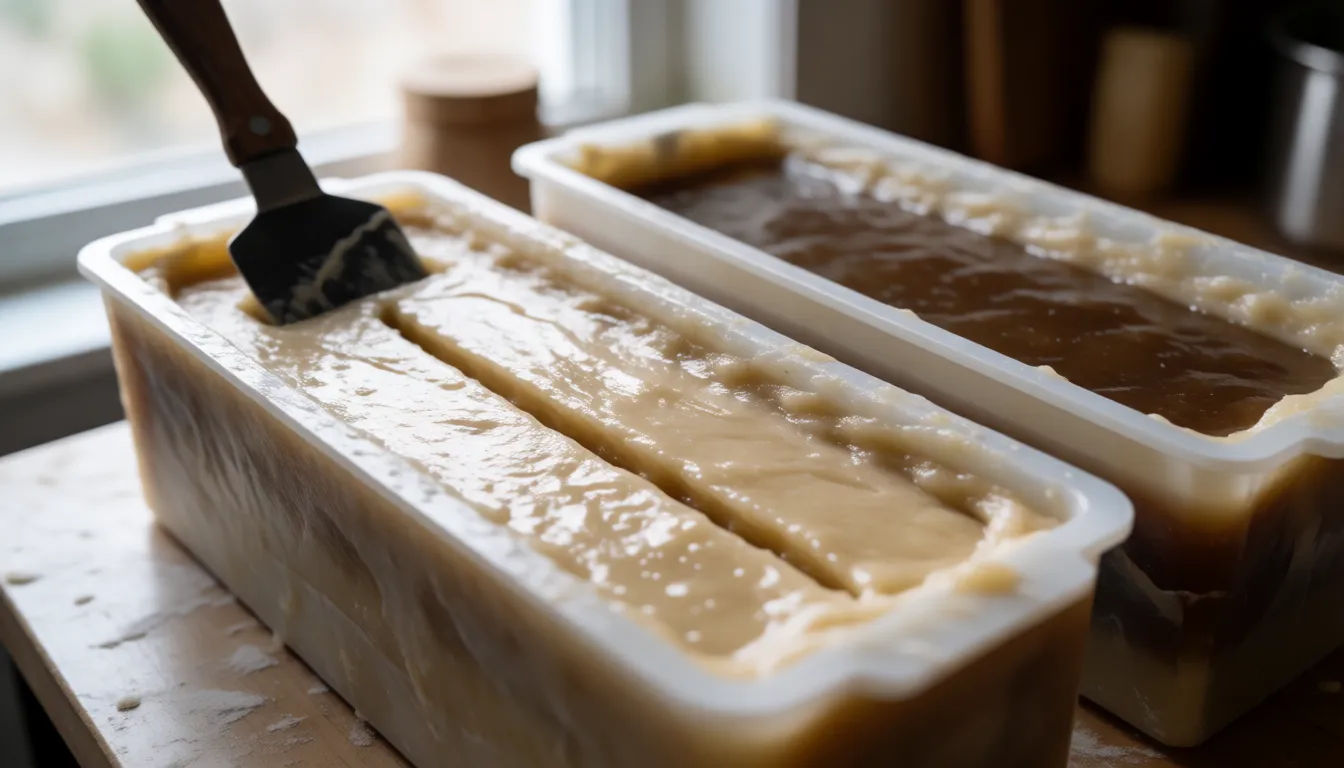
Trace, heat and gel are the visible events in a batch, and they are easy to mistake for a finish line. They show the reaction is under way. None of them shows it is finished.
- Trace is the point where the batter thickens enough to hold a line on its surface. It thickens because soap is forming, and soap is an emulsifier: it holds oil and the water-based lye solution together. But at trace only a fraction of the reaction has happened. Reaching it says nothing about how much lye is left unreacted.
- Heat appears because saponification is exothermic, meaning it releases energy. Warmth in the mold tells you the reaction is running. It does not tell you how far along it is.
- Gel is a phase change in the soap paste. The heat can push the center of the batch into a translucent, more fluid state that spreads outward. A batch that gels and one that doesn't both saponify. Gel changes color and texture, not whether lye remains.
| What you see | What it shows | What it doesn't show |
|---|---|---|
| Trace | Soap is forming and emulsifying | How much lye is still unreacted |
| Heat in the mold | The reaction is exothermic and running | How complete it is |
| Gel phase | Enough heat to change the paste's phase | Whether any lye remains. A bar that never gels saponifies just as well |
Completion cannot be seen. It rests on three things: a recipe calculated correctly for your actual oils, lye and oils weighed accurately (see Weigh, Not Volume, for Safe Lye Math), and enough time. In cold process soap the reaction is essentially complete within about 24 to 48 hours, and in hot process the cook finishes it before the soap goes into the mold. The four-to-six-week cure that follows is mostly water leaving the bar, which makes it harder and longer-lasting. It is not the lye finishing its work. Given those three things, the hydroxide is consumed and a properly formulated bar has no free lye. A superfat also means the recipe is built to have oil left over rather than lye. If something went wrong, such as a miscalculation, a scale error or a missed ingredient, you can end up with excess lye. Lye Heavy Soap: How to Tell, Fix It or Toss It covers that case.
You can confirm a bar is done only by testing it, never by how it looks or feels. The zap test is a quick check that can flag a lye-heavy bar: you touch a small piece of soap to your tongue and note whether it gives a sharp, electric sting. It is a sensation check, not a measurement. How to Zap Test Soap Safely, and What a Zap Means explains how to do it and how to read the result. For the batch procedure itself, including insulating and handling gel, see How to Make Soap: A Beginner's Cold Process Soap Recipe.
Where to go next
- Run your own oils and superfat through the Soap Brain lye calculator to get the lye and water for your batch.
- Read Soap Calculator Numbers Explained: What to Trust for why calculators differ and how to choose one.
- If a bar seems off, Cold Process Soap Problems: What's Wrong and How to Fix It is the place to start.
More from the blog
- How to Make Liquid Soap: KOH Paste, Dilution, Fixes
- How to Make Breastmilk Soap: Melt and Pour or Cold Process
- Essential Oils for Soap Making: Rates, Picks and Fixes
- Soap pH: What's Normal, Why It's Alkaline, How to Test
- Master Batching Soap: 1:1 Lye Solution and Oil Blends
- Tallow Soap Recipe: A Hard, Long-Lasting Cold Process Bar
- All posts →