Guides
How to Make Liquid Soap: KOH Paste, Dilution, Fixes
By The Soap Brain Team — Cold-process soap makers & formulators
·
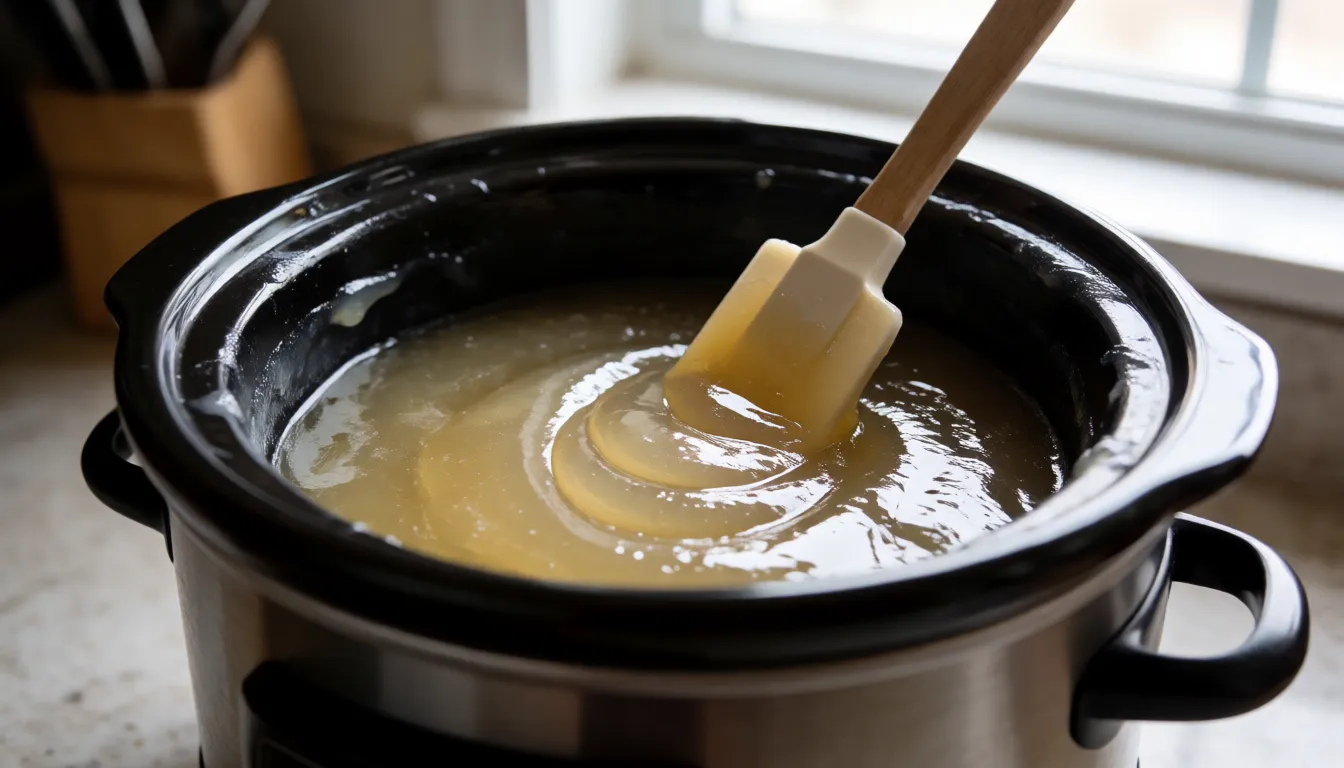
Making liquid soap from scratch is a different process from making bars, and melting grated bar soap in water doesn't get you there. True liquid soap uses potassium hydroxide (KOH) instead of sodium hydroxide, a lye calculator set to KOH, and two stages: you cook a thick soap paste, then dilute it into liquid. Below is a full recipe for a liquid castile and a liquid hand soap, with what each stage should look like, how to thicken it, and how to fix the batches that go cloudy, oily or thin. Grated bar soap gets its own fair comparison near the end.
The Short Answer: Two Stages, KOH, and Why Grated Bar Soap Doesn't Count
Can you use your regular bar recipe, or grate a bar into hot water? Not for real liquid soap. Bar recipes are built around sodium hydroxide, which makes hard soap. Potassium hydroxide makes soft soap that dissolves in water and stays liquid. You can't swap one for the other at the same weight, because the two lyes need different amounts for the same oils. That's why you need a calculator that has a KOH setting, and why every lye figure here comes from it.
Grated bar soap melted in water makes a gel or slurry. It's a perfectly good trick for laundry, but it's cloudy, lumpy and prone to separating, and you can't design it the way you can a real liquid soap. I'll lay out the differences in the comparison near the end.
The real method has three parts:
- Make the paste. Mix KOH solution with oils and blend to trace.
- Cook it. A few hours in a slow cooker until the paste turns glossy and translucent.
- Dilute it. Dissolve the paste in hot distilled water and glycerin, then thicken if you want a pump-bottle texture.
What You're Making: Liquid Castile vs. Liquid Hand Soap
I'm giving you two recipes so you can pick your project.
Liquid castile is 100% olive oil. It's simple, mild and gentle. It's also thin and can turn a bit cloudy or yellowish, which is normal for olive oil. It's a good base for refilling bottles and a good first batch because there's only one oil to weigh.
Liquid hand soap uses olive, sunflower, coconut and castor oils. The coconut brings bubbles and cleaning power, the castor adds lather that lasts, and the olive and sunflower keep it mild and clear. This is the one to make if you want something for a pump bottle by the sink.
Neither needs a cure. Once the paste is diluted and dissolved, the soap is ready to use. That's a nice change from waiting four to six weeks on bars.
Before You Start: Gear and Lye Safety
Gear list:
- A digital scale that reads to the gram
- A slow cooker (a dedicated one, not the one you make chili in) or a double boiler
- A stick blender
- Heat-safe containers and spatulas for lye and oils
- A thermometer that reads up to at least 100°C
- Distilled water
- Vegetable glycerin
- Lidded jars or bottles for the finished soap
Lye safety, once: wear goggles, gloves and long sleeves, and work with good ventilation. Always add lye to water, never water to lye. If any splashes on skin, rinse with plenty of running water for at least 15 minutes. If it gets in your eyes, rinse them the same way and get medical help right away. The hot paste can spit and pop as it cooks, so keep your face back and keep the lid handy. For containers, storage, purity and first aid in more depth, see KOH Safety for Liquid Soap: Handling, Paste and Dilution.
The Recipes and Your Calculator Settings
Liquid castile (500 g of oils)
| Oil | Grams | Percent |
|---|---|---|
| Olive oil | 500 g | 100% |
Liquid hand soap (600 g of oils)
| Oil | Grams | Percent |
|---|---|---|
| Olive oil | 240 g | 40% |
| Sunflower oil | 150 g | 25% |
| Coconut oil | 150 g | 25% |
| Castor oil | 60 g | 10% |
To scale, keep the percentages and change the total. If you want to know what each oil brings to a recipe, this oils guide covers them.
Open the Soap Brain lye calculator, enter your oils, and set it up like this:
- Soap type: Liquid soap (KOH). That one choice switches the lye to KOH, sets a 3% superfat and sets the paste water to a 30% lye concentration. Check that the lye type now reads KOH, not NaOH.
- Purity: open "Show advanced options" and match the percentage on your KOH label. The calculator assumes 90%, which is typical for KOH flakes, but your label is the one that counts.
- Water: the preset's 30% is a good middle ground for cooking paste. If you'd rather use the classic, slightly wetter 3 parts water to 1 part KOH, pick "Water : lye ratio" and enter 3. It gives a slightly softer paste.
- Superfat: leave it at the preset's 3%, or go down to 1–2% for a clearer soap. I use 2%.
About that superfat: you'll find makers recommending a negative superfat for extra-clear soap, and others saying 3% or under. A negative number means leaving extra lye in a soap that goes on your hands, and I won't do that. A small positive superfat keeps the soap clear without leaving lye behind. Run the numbers yourself in the calculator rather than taking mine on faith. If you want to understand what the calculator's outputs mean, Soap Calculator Numbers Explained: What to Trust helps. Weigh everything in grams, as covered in Soap Making: Weigh, Not Volume, for Safe Lye Math.
Write down the calculator's lye and water weights before you start, and double-check that KOH is selected before you weigh anything.
Step 1: Mix the Lye Solution and Blend to Trace
Weigh the KOH and the water separately, using the calculator's numbers. Use a heat-safe, sturdy container, because the solution gets very hot and gives off fumes as the KOH dissolves. Mix in a ventilated spot with your goggles and gloves on, and don't lean over the container. Add the KOH to the water, stirring until it dissolves. Then set it somewhere safe, away from children and pets, until it has cooled to about 50°C. That usually takes 20 to 30 minutes, and it's worth putting the thermometer in rather than guessing.
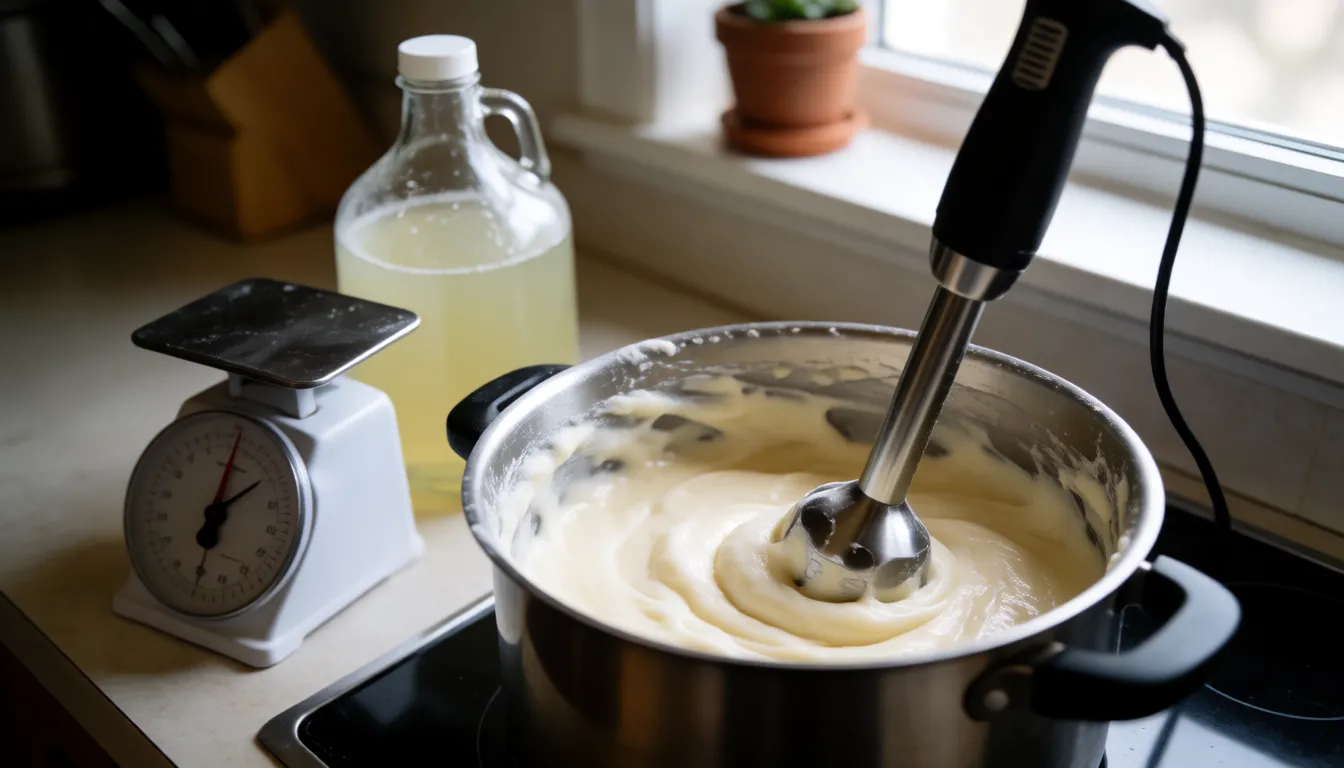
While it cools, melt any solid oils (the coconut, in the hand soap), then combine all the oils in the pot you'll cook in. Aim for the oils to be about 50-60°C when the lye solution goes in. If you're using the slow cooker, you can do the blending right in the insert. Pour the lye solution into the oils and start stick blending in short bursts.
Don't walk away. Liquid soap batter traces fast, within minutes. It goes from cloudy liquid to a thick pudding, sometimes so thick the blender labours. I once stepped away to answer the door and came back to a pot I could have stood a spoon in. Blend in bursts, rest, blend again, and stop when it's a thick, opaque pudding. That's your cue to move on to the cook.
Step 2: Cook the Paste
Put the lid on the slow cooker and set it to low, or set a double boiler over gently simmering water. Plan on about 2-4 hours in total.
The approach I like: cover it and leave it completely alone for about 30 minutes. Then stir and cook roughly another hour, until it's mostly translucent. From there, check every so often until it looks finished.
Here's what you'll see along the way:
- Thick, opaque mashed potato. Right after blending, the batter looks pale and heavy. Normal.
- Gel with glycerin streaks. As it heats, parts of the batter turn darker and glossy, with streaks and pockets of clearer gel. It looks alarming and it's fine. Stir it together, and it becomes more uniform.
- Glossy, translucent, vaseline-like paste. The whole mass turns see-through and waxy, like petroleum jelly. That's the finish line.
Stir gently, and if the paste climbs the sides of the pot, stir it back down.
How to Know the Paste Is Done
Look for the vaseline stage: a glossy, translucent, waxy paste with no opaque white patches or cloudy streaks. Opaque spots mean it needs more time, so keep cooking and stir it.
Once I called a paste done because most of it looked right. The centre had a few cloudy pockets I missed, and the diluted soap came out hazy with a faint oily film on top. Now I break the paste up and check all the way through before I stop.
Before you dilute the whole pot, do the clarity test. Drop a marble-sized piece of paste into about 100 g of boiling distilled water and stir until it dissolves. Clear or only slightly hazy means the paste is done. Milky white means there's still unreacted oil, so cook it another 30 minutes and test again.
Looking done isn't the same as being safe, though. Once the soap is diluted, check it with a pH strip before you use it, as described in the KOH safety guide linked in the safety block above.
Step 3: Dilute the Paste
Dilution is calculated from the weight of your finished paste, and the useful range runs from 50% to 200% of that weight. Weigh the paste (subtract the weight of the pot) and use this starting formula, which is a 100% dilution:
- Glycerin: paste weight × 0.2
- Hot distilled water: paste weight × 0.8
So 1,000 g of paste would get 200 g of glycerin and 800 g of hot distilled water. That's the same 1× starting point the calculator's dilution box uses.
Start low. You can add water later, but you can't take it out. If you'd rather begin at a 50% dilution, halve those numbers and adjust as you go.
Heat the water and glycerin together to hot but not boiling, about 80°C. Then add the paste in spoonfuls, and don't stir hard. Let the pieces sit in the hot liquid and soften. Put the lid on. As the pot cools, reheat it gently whenever you like (well short of a simmer) and let it rest again. This can take several hours to a few days, and the pot doesn't need babysitting.
My own guideline is to check it after 12-24 hours. Some pastes are fully dissolved by the next morning, and some need a couple of days. Lumps after a full day are normal, so reheat gently, rest, and check again.
What done looks like: a fully dissolved soap is smooth and clear to golden, with no lumps, jelly-like bits or oily film. If it's still hazy, return it to gentle heat and rest it overnight. If it's still hazy after that, stir in a splash of hot distilled water (about 5% of the paste weight) and rest another 12-24 hours. Once it's clear, you have liquid soap. If it's thicker than you like, add a little more hot distilled water and rest again.
Step 4: Thicken It for a Pump Bottle (or Don't)
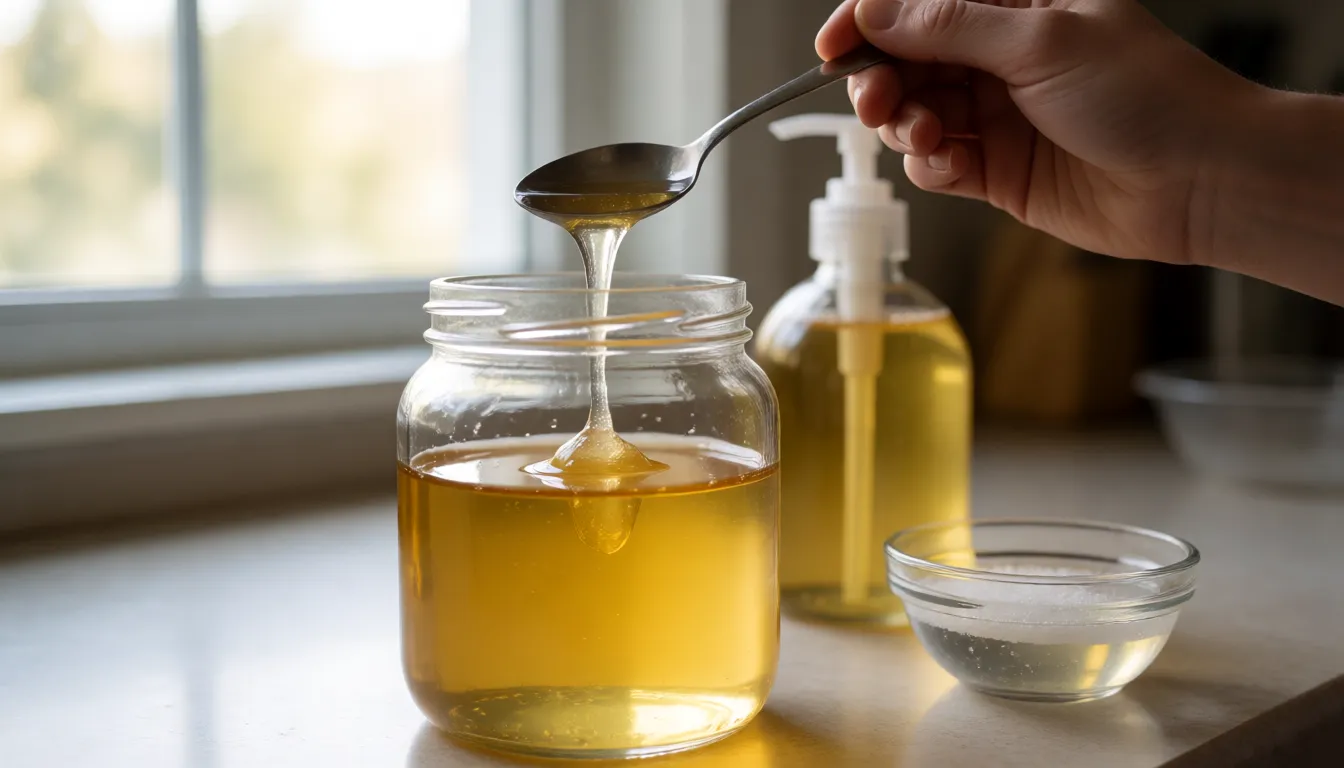
Freshly diluted liquid soap is usually thinner than the stuff you buy. If it flows through a pump without a fuss, you can stop here. Castile in particular is often happiest left thin, and thickening it isn't required.
If you want more body, you have two routes. Go in small steps, write down what you've added, and stop when it feels right.
Salt solution. Make a 20% salt solution by dissolving 20 g of plain salt in 80 g of warm distilled water. Add it about 1% of the soap's weight at a time (5 g for 500 g of soap), stir gently, and wait at least 10 minutes between additions, because it thickens gradually. Salt has a sweet spot: past it, more salt makes the soap thinner again, cloudy or separated, so stop at the first addition that gets you close. A good test is to lift a spoonful and watch it run back: you want a slow, thin ribbon, not a rope. Salt suits the hand soap, with its coconut oil, much better than castile, which barely thickens with it.
Gums (HEC or guar). These make a smoother, gel-like thickness. Start at 0.5% of the soap's weight (2.5 g for 500 g of soap). Stir the gum into three or four times its weight of glycerin first so it doesn't clump into fish-eyes, then stir that slurry gently into the soap. Cover it and give it 12-24 hours before you judge it, because gums keep thickening for hours after you add them. If it's still too thin, add another 0.25% the same way and wait again. Most soaps don't need more than about 1%.
Whichever you use, thicken before you scent. You can add more, but you can't undo it.
Scent and Colour
Use your supplier's recommended rate for each fragrance oil or essential oil. Safe amounts differ from oil to oil, so I don't give a general number. Here's how to turn the rate into grams:
grams of scent = weight of soap × (supplier's rate ÷ 100)
For example, if your supplier says the rate is 1% and you're scenting 500 g of finished soap, that's 500 × 0.01 = 5 g. Use your supplier's actual figure and weigh it on your scale.
Test in a small sample first. Some fragrance and essential oils cloud liquid soap or make it separate, and it's much better to find that out in a small jar than in a full batch. If an oil won't stay mixed, a solubilizer can help. Follow your supplier's guidance for the product and the rate.
Colour is easier to overdo than to fix, so add a little at a time, stir gently, and remember that olive oil already gives the soap a golden tint.
Troubleshooting: Cloudy, Oily, Separated, Too Thin, or Won't Dissolve
Cloudy soap
- Likely causes, most common first: the paste wasn't fully cooked; a scent or essential oil is clouding it; tap water was used instead of distilled; or the soap is cold.
- How to tell: if the paste had opaque patches when you diluted it, that's your culprit. If cloudiness appeared right after you scented, it's the oil. If it clears when warmed, it's just cold.
- Rescue: warm it gently and rest it. If the paste was undercooked, put the diluted soap in the slow cooker on low with the lid on for about 2 hours, until it's hot but not simmering (roughly 70-80°C on your thermometer). Stir gently every 30 minutes, then rest it overnight and check again.
- Next time: cook until the whole paste is glossy and see-through, use distilled water, and test scents in a small jar.
Oily layer on top
- Likely causes: the paste wasn't cooked long enough, or the superfat is too high.
- How to tell: an oil film that reforms after you stir.
- Rescue: return the diluted soap to gentle heat (slow cooker on low, lid on, about 70-80°C) for 1-2 hours, stirring gently now and then, then rest it overnight. If the film is still there, stir in a splash of hot distilled water (about 5% of the soap's weight) and rest another 12-24 hours. Skim off any oil that remains.
- Next time: keep superfat in the 1-3% range and cook until the paste is fully clear.
Separated soap
- Likely causes: thickened too far with salt, water was added too fast, or a scent that won't stay mixed.
- How to tell: layers or curds that don't blend when stirred.
- Rescue: warm it gently and stir slowly. Adding a bit more hot distilled water can bring it back.
- Next time: add thickener in small steps and test scents in a sample.
Too thin
- Likely causes: diluted too far.
- How to tell: it runs like water.
- Rescue: thicken with salt solution or a gum, as in Step 4.
- Next time: start with a lower dilution, such as 50-75%, and add water gradually.
Paste won't dissolve
- Likely causes: not enough time or heat, or too little liquid.
- How to tell: lumps of paste still floating after a full day.
- Rescue: reheat gently, keep the lid on, and rest it again, stirring softly whenever you pass by. It can take a couple of days. If the lumps barely shrink, add a splash of hot distilled water.
- Next time: add the paste in spoonfuls to hot liquid, and give it the full resting time.
For anything that seems more like a lye problem, see Lye Heavy Soap: How to Tell, Fix It or Toss It.
Grated Bar Soap vs. Real Liquid Soap: A Fair Comparison
Melting grated bar soap in water isn't chemistry gone wrong. It's a different product with a different job.
| Grated bar soap in water | Real liquid soap | |
|---|---|---|
| Lye at the bench | None (you start with a finished bar) | KOH, handled carefully |
| Time | Short | A few hours of cooking, plus dilution and resting |
| Look | Cloudy, lumpy, gel-like | Clear to golden, smooth |
| Stability | Can separate | Stays mixed when made well |
| Dilution | Hard to control | Designed and adjustable |
| Custom formula | Limited by the bar you started with | Yours to design |
The shortcut is the right choice when you want a cheap laundry gel or a rough liquid for cleaning chores, or when you don't want to handle lye at all. If you want a smooth hand soap in a pump bottle, or a castile you can refill from, do the real thing. If you'd like to see where liquid soap sits among other methods, Types of Soap Making: Which Methods Use Lye is a good survey.
Storage, Use, and Your First Small Batch
Store the soap in clean, lidded jars or bottles. Using distilled water for dilution helps prevent spoilage and discolouration. You can use it as soon as it's diluted and dissolved, with no cure. If it gets cloudy in a cold room, warm it up and it should clear.
For your first go, make a small batch. The castile recipe at 500 g of oils is plenty, and even that makes a lot of soap once it's diluted. A small batch means less to lose if something goes cloudy, and you learn what each stage looks like. Then, once you've seen the paste go from mashed potato to vaseline, scale up and try the hand soap.
If you want to stay in familiar territory between batches, there's a classic castile bar recipe and a whole library of cold process recipes to keep you busy while your paste cooks.
More from the blog
- What Is Saponification? How Oil and Lye Become Soap
- How to Make Breastmilk Soap: Melt and Pour or Cold Process
- Essential Oils for Soap Making: Rates, Picks and Fixes
- Soap pH: What's Normal, Why It's Alkaline, How to Test
- Master Batching Soap: 1:1 Lye Solution and Oil Blends
- Tallow Soap Recipe: A Hard, Long-Lasting Cold Process Bar
- All posts →