Safety
KOH Safety for Liquid Soap: Handling, Paste and Dilution
By The Soap Brain Team — Cold-process soap makers & formulators
·
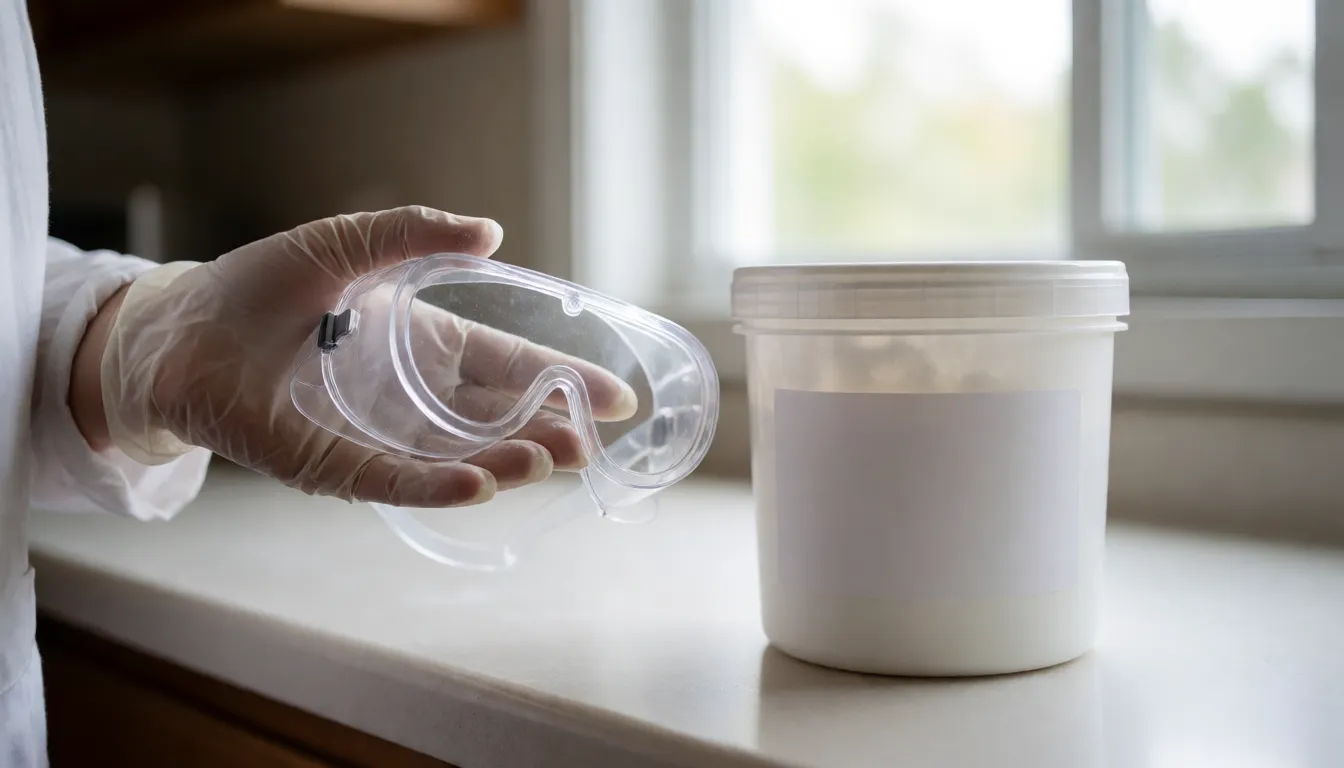
Potassium hydroxide (KOH) is a strong caustic base in the same hazard class as sodium hydroxide (NaOH). It burns skin and eyes, and its dust and mist irritate the lungs. The answer is "same class, same rules": everything you already do with NaOH applies unchanged. What differs is the handling around it: how fast the flakes take on moisture, how purity affects your weights, and the extra stages in liquid soap, where a hot paste is cooked and then diluted.
Same hazard class as NaOH, so the same rules apply
A KOH solution sits around pH 13-14, the same range as a NaOH solution. At that alkalinity it dissolves skin proteins and fats, which is why a splash feels slippery before it starts to burn, and why eyes are the most vulnerable spot. Wikipedia's entry on potassium hydroxide describes solutions as irritating at low concentration and highly corrosive at high concentration.
The rules that carry over are goggles, gloves, long sleeves, ventilation, and always adding the alkali to the water, never the reverse. The sections below cover what is different about KOH, then follow the liquid-soap workflow from gear through checking the result, and close with first aid and keeping kids and pets safe.
What is different about KOH
Weight per hydroxide. Soap forms when a fat reacts with hydroxide ions. A potassium hydroxide unit has a molar mass of about 56.1 g/mol, while sodium hydroxide's is about 40.0 g/mol. Since 56.1 ÷ 40.0 is roughly 1.4, KOH weighs about 40% more per hydroxide unit. That is why a lye calculator gives different weights for the two alkalis. It is arithmetic the calculator handles for you, not a conversion to do by hand. Oil SAP values are expressed in mg KOH per gram of oil, so KOH is the calculator's native unit anyway.
Moisture. KOH flakes are hygroscopic, meaning they pull water out of the air. Left open, they turn tacky, then clump, then can turn wet. The storage and weighing sections below deal with the consequences.
Extra stages. Liquid soap doesn't stop at a poured, set bar. The soap is cooked into a hot paste and then diluted with water. Both stages carry their own hazards, covered later.
Gear and ventilation
Wear splash-proof goggles (not glasses), chemical-resistant gloves, long sleeves, closed shoes, and long pants. Keep your hands, gloves, and work surface dry while you handle the flakes, because moisture on the flakes creates caustic solution on contact. A flake that lands on a wet countertop becomes a caustic puddle, so wipe up strays right away.
Ventilation matters because of dust and mist. Flakes can throw off fine dust when scooped or poured, and dissolving KOH releases a hot mist. Inhaling either can severely irritate the airways, and in serious inhalation cases it can cause pulmonary edema, fluid in the lungs. NIOSH lists a ceiling exposure limit of 2 mg/m³ for KOH, and OSHA has set no permissible exposure limit. That is an industrial workplace figure, not a target for a home kitchen. It's useful only as context for why even small amounts of airborne KOH are taken seriously. Work near an open window or under a fan that vents outdoors, and keep your face back from the container while stirring.
Containers and tools
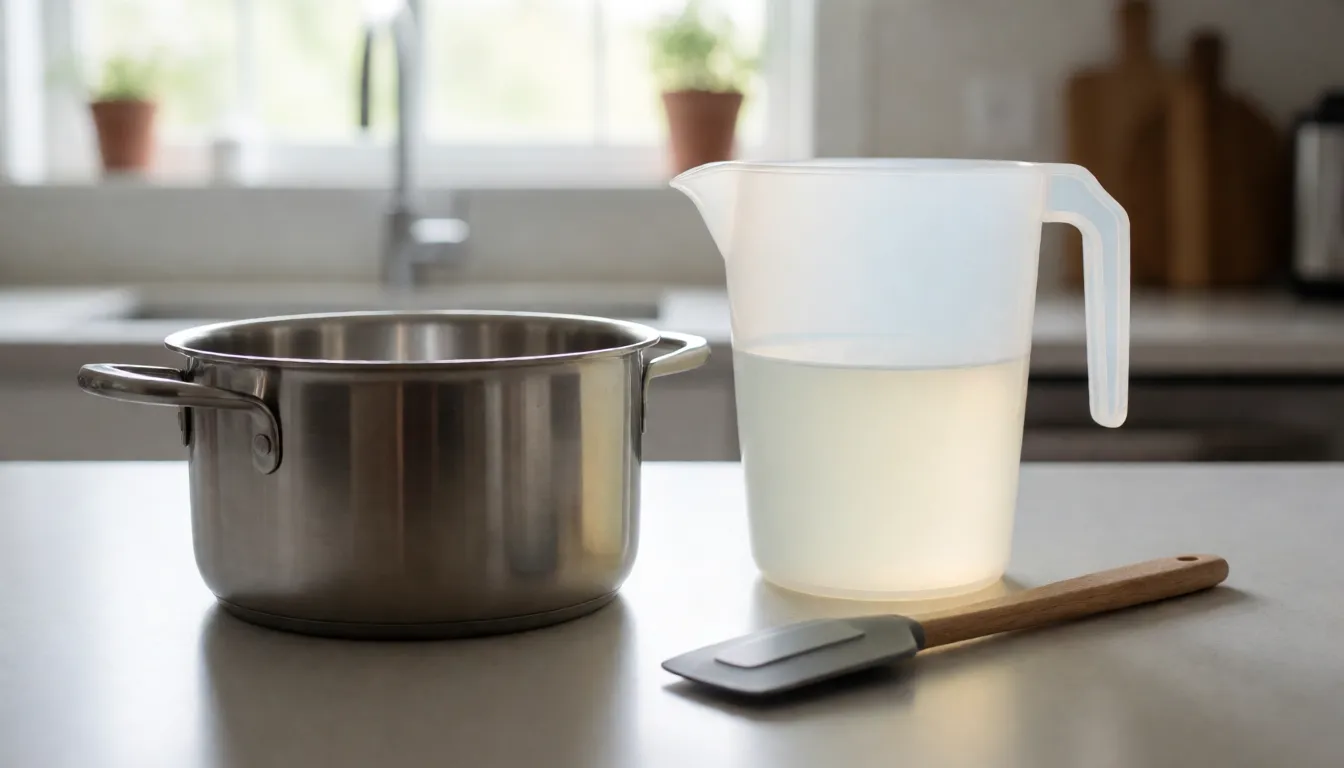
Confirm that every spoon, whisk, and pot that touches KOH flakes or solution is stainless steel, polypropylene, or silicone, and not aluminum. Heat-safe polypropylene is often marked with the recycling code 5. All three materials resist strong alkali and tolerate the heat of dissolving.
Aluminum is out entirely. Lye attacks aluminum and releases hydrogen gas, which is flammable, and the container is ruined in the process. That includes aluminum pots, foil, and utensils.
Glass is a special case. Dissolving KOH heats the water quickly, and ordinary glass can crack from thermal shock. Use only glass rated for thermal shock, if you use glass at all. Stainless steel or polypropylene avoids the question. Whatever you choose, keep those containers and tools dedicated to soap, and never use them for food afterward.
Storing KOH
The flakes turn tacky and clumpy for two reasons. First, they absorb water vapor, which is the hygroscopic behavior. Second, they react with carbon dioxide in air, and the main product is potassium carbonate. Potassium bicarbonate can form only when there is excess CO₂, so carbonate is the accurate answer for a bag left open in a room. Both changes mean the flakes are no longer pure KOH.
To slow this down:
- Transfer the flakes into a rigid, tightly sealed, labeled container, preferably one with a screw-on lid.
- Store it somewhere cool and dry, away from steamy bathrooms and sink cabinets.
- Label it with the contents and a hazard warning, and never use a food or drink container.
- Keep it away from acids and out of reach of children and pets. NIOSH lists acids, and metals when wet, among KOH's incompatibilities.
Purity, carbonates, and weighing
Buy KOH from a soap-making supplier, as flakes or pellets, and read the label before it goes in your cart. It should state the purity and carry hazard information. KOH is commonly sold at about 90% purity. The rest is mostly water and carbonates, which is unavoidable in a manufactured, hygroscopic product.
Enter the purity from the label into the Soap Brain lye calculator, which adjusts the weight so the batch gets the amount of actual KOH it needs. Don't nudge the number by hand, and don't round it in your own head. Purity adjustment done twice, once by you and once by the calculator, is one way batches go wrong.
Flakes that have sat open are less predictable, since some of the weight is now water or carbonate beyond what the label says. That is the reason to weigh fast and reseal the container right away, and to avoid using flakes that have turned wet or hard. Use a digital scale, tare your container, and don't weigh over open food or other ingredients. Recheck the number against the calculator before you dissolve anything.
Dissolving KOH in water
Add the flakes slowly to the water, stirring as you go. Never pour water onto a pile of flakes. Dissolving KOH is strongly exothermic, meaning it gives off a lot of heat. If water lands on a mound of flakes, all that heat concentrates in one spot and can spit or boil violently. With flakes added gradually to a larger volume of water, the heat spreads through the liquid.
Expect the container to get hot and the mist to rise, so keep your face back and the window open. Use a container large enough that the solution can't slop over the rim, and let the solution cool before it meets oils.
The hot paste stage
In the common hot-process method for liquid soap, you combine the cooled KOH solution with your oils and cook the mixture until it becomes a thick, translucent paste. The paste stage is where saponification completes, and the paste stays caustic until it is fully cooked, because until then some KOH hasn't yet reacted with fat. Follow your recipe's instructions for judging when the cook is done, and treat the paste with the same gear and care as the lye solution the whole time.
Hot paste also splatters. It's thick, it holds heat, and it can bubble up or spit when stirred or when steam builds beneath the surface. Use a pot with generous headroom, and don't lean over the pot to look inside. Anything that lands on skin is both hot and alkaline.
Dilution
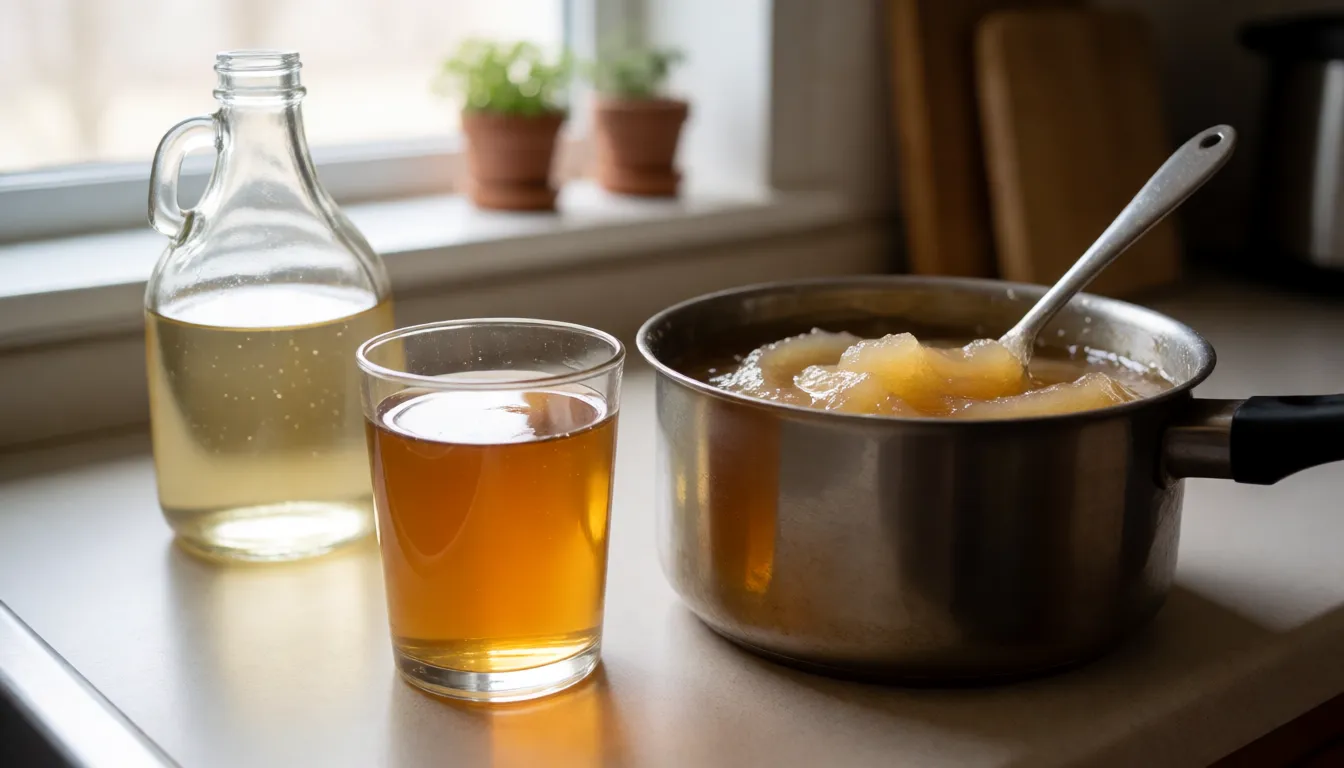
Once the paste is fully cooked, you dilute it with water to turn it into pourable liquid soap. This stage has two hazards: the mixture is hot, and it may still be caustic if saponification was incomplete.
The hot one comes first. Water added to hot paste can flash to steam at the contact point, and hot liquid can splash out with it. Add the water carefully, in portions rather than all at once, and stir gently. Use a container with plenty of headroom so the mixture has room to foam and rise, and keep your face back from the steam.
Dilution is also the point where you can check how the earlier stages went. A well-made paste dissolves into a clear or evenly tinted liquid. Cloudiness, separated oil, or a greasy layer is a prompt to check, not a diagnosis. These signs can point to an error in the numbers or an incomplete cook, but they also have other common causes, such as minerals in the dilution water. When you see them, go back over your recipe, your calculator entries (including the purity you entered), and your weights, then test the pH as described in the next section. Catching a problem here is much better than catching it after bottling.
For a deeper walkthrough of the process itself, see the Soapindex guide to liquid soap making with KOH.
Is there KOH left in the finished soap?
Properly calculated, fully saponified soap contains no free KOH. In saponification the potassium hydroxide reacts with fats and is consumed, leaving potassium soaps and glycerin. The KOH is chemically converted, not just mixed in.
The important qualifiers are "properly calculated" and "fully saponified." If the recipe used too much KOH for the oils, whether from a calculator error, a wrong purity entry, or a mis-weighed batch, the extra is left as free alkali. If the cook wasn't completed, some KOH may not have reacted yet. Time alone doesn't fix either problem. This is also why you enter the label purity and recheck every number.
To check, dip a pH strip into a small sample of the diluted soap held on a clean stainless or plastic spoon, and compare it to the strip's color chart. A strongly alkaline reading means the batch should not be used on skin until the calculation and the cook have been reviewed.
Strips are a useful check but a blunt one. They give a rough reading, not a precise value, their color steps are wide, and soap's own color can make them hard to read. A reasonable-looking reading doesn't prove the batch is perfect. Treat strips as one signal alongside how the paste behaved, how the diluted soap looks, and whether your numbers were right to begin with. For the chemistry in more depth, the CleanFormulation guide to liquid lye soap is a good companion.
If something goes wrong
This is the short version of the essentials.
- Skin or eyes: Flush with running water for at least 15 minutes. Remove contaminated clothing and jewelry while flushing. Keep the eyes open and rinsing.
- Swallowed: Call Poison Control (US 1-800-222-1222). Do not induce vomiting.
- No vinegar. Don't try to neutralize KOH on skin or in the eyes. The reaction generates more heat, and water is the treatment.
- Serious exposure or inhalation trouble: Get medical attention right away.
Keeping kids and pets safe
Most of this comes back to storage and attention. Keep the flakes sealed, labeled, and high or locked away. Keep children and animals out of the room while you weigh, dissolve, cook, and dilute, and shut the door if you can.
Never leave a container of lye solution or hot paste unattended, even for a minute, and don't set it down where a pet or a child could reach it. A hot, unlabeled pitcher of clear liquid looks like water to a child or a guest, so label every container. Clean up all flakes and drips before you let anyone back in, and wash every tool that touched KOH.
More from the blog
- Lye Safety for Soapmakers: Gear, Airflow, and First Aid
- Lye Burn First Aid: What to Do for Skin, Eyes and More
- Soap Making: Weigh, Not Volume, for Safe Lye Math
- How to Zap Test Soap Safely, and What a Zap Means
- Lye Heavy Soap: How to Tell, Fix It or Toss It
- What Is Saponification? How Oil and Lye Become Soap
- All posts →