Guides
Master Batching Soap: 1:1 Lye Solution and Oil Blends
By The Soap Brain Team — Cold-process soap makers & formulators
·
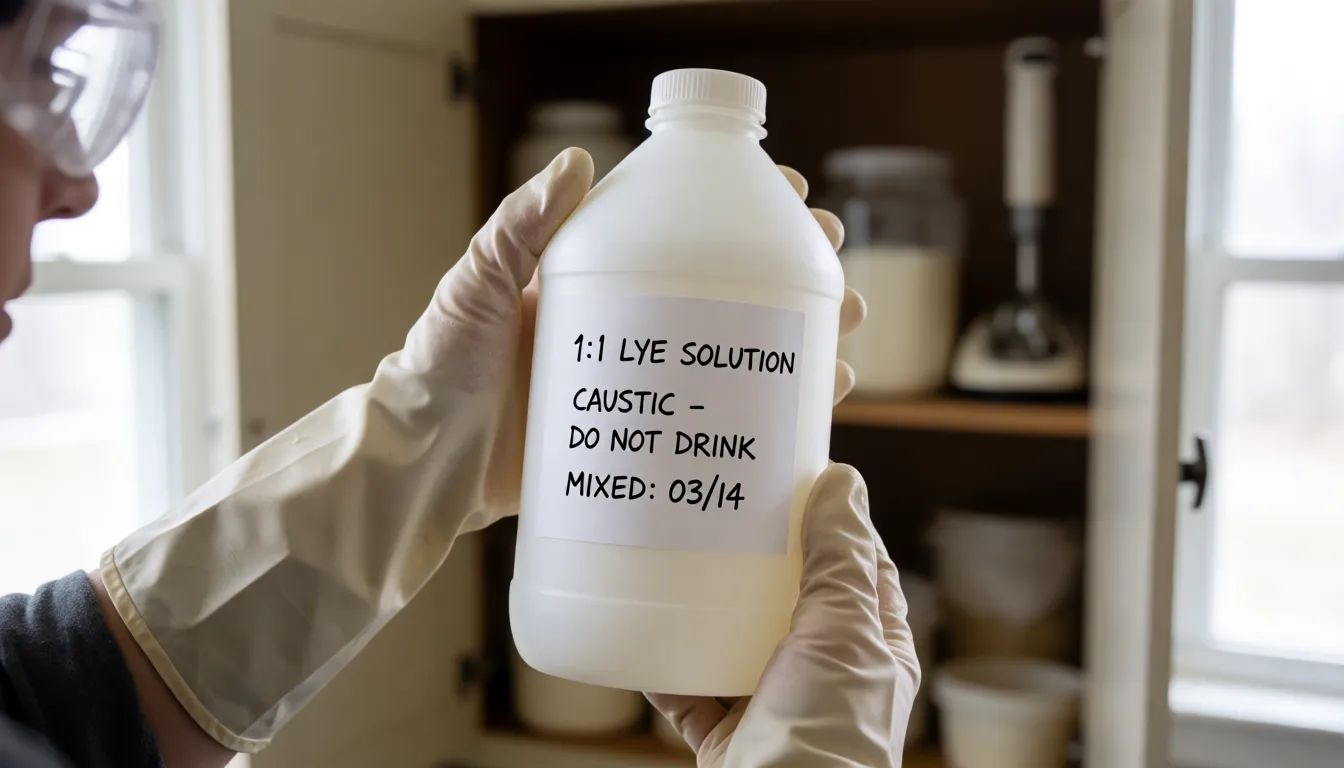
Master batching means mixing your lye solution, your oil blend, or both ahead of time, so a soap day starts with pouring instead of weighing and stirring. For lye, the usual move is a 1:1 solution: equal weights of lye and distilled water, mixed once, stored in a labeled HDPE jug, and diluted to the right strength for each recipe with some simple arithmetic. For oils, you multiply a recipe you trust, blend it in a lidded bucket, and weigh out of it. This article covers lye first, because that's the part that makes people nervous, then oils, then what goes wrong.
Is master batching worth it for you?
If you make the same two or three recipes most weekends, yes. Weighing the same oils and mixing the same lye water every time is tedious, and every repeat is another chance to misread the scale. A master batch cuts the prep, the number of buckets to wash, and the number of times you handle dry lye.
It's not worth it if you make one batch a month. Oils sitting in a bucket for weeks can turn, and a jug of lye solution in the house is a responsibility for very little time saved. Mix fresh for each batch and skip the jug you'd otherwise have to label, store and keep an eye on.
The sweet spot is a maker who makes a batch or more every couple of weeks, or who is scaling up and wants fewer chances for a slip. If that's you, keep going. The lye comes first.
Mixing a 1:1 lye master batch
A 1:1 solution is equal weights of lye and distilled water. Half the weight of the jug is lye, so it's strong stuff, and that's the point. Because the ratio is known and fixed, you can turn it into any recipe's lye water with simple math (next section). A ready-to-use solution mixed at your usual concentration is simpler if you only ever make one recipe, but it locks you in. If you tweak recipes, or your water discount changes, 1:1 is the flexible choice.
Everything here is for sodium hydroxide, the lye for bar soap. Potassium hydroxide for liquid soap is usually master batched weaker, around 33 to 45% lye, because a stronger KOH solution tends to crystallize in a cool room. Don't reuse the 1:1 numbers for it.
Lye safety, once, here where you need it: wear goggles, gloves and long sleeves, and work with good ventilation. Always add the lye to the water, never the water to the lye. If any splashes on your skin or in your eyes, rinse with plenty of running water right away. For gear, airflow and first aid in more depth, see Lye Safety for Soapmakers: Gear, Airflow, and First Aid.
Then:
- Pick a batch size that fills your storage jug to no more than 80% (more on that in the storage section). Weigh out equal parts lye and distilled water on your scale. This is the one time the lye amount doesn't come from the calculator. It comes from your jug.
- Put the cold distilled water in a heat-safe HDPE container or pitcher. Cold water keeps the heat and steam down, and 1:1 gets hotter than a normal lye water anyway.
- Add the lye to the water slowly, stirring as you go, with a spoon that lives with your soap gear and nowhere else. Stir until it's clear.
- Let it cool fully, with the lid off or resting loosely on top. Don't seal it while it's hot. Give it hours, not minutes.
- Once it's completely cool, pour it into the storage jug, screw the cap on, label it, and put it away. Labels are covered below.
Turning the calculator's numbers into solution plus extra water
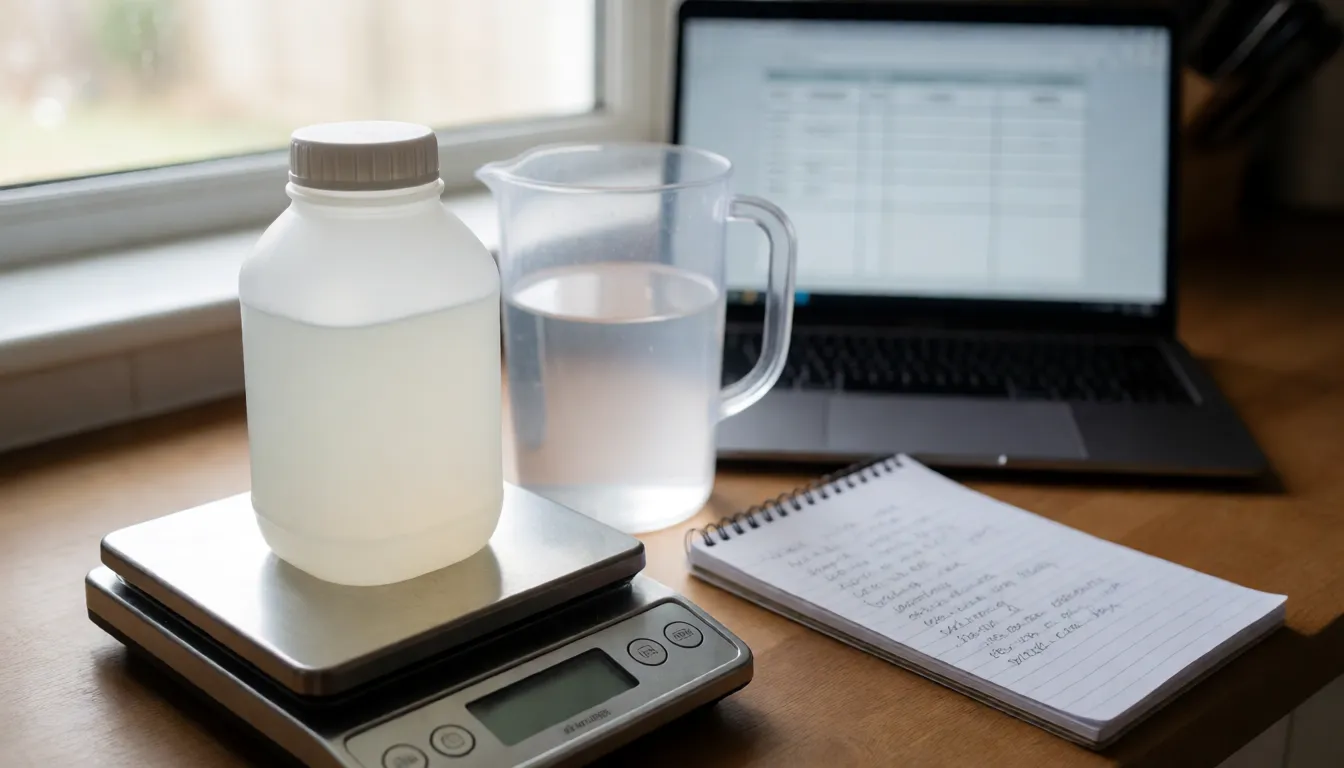
Run your oils through the Soap Brain lye calculator the way you always do. It gives you two numbers that matter here: the lye weight and the water weight. Call them L and W. I'll keep them as letters, because the calculator gives you your own.
Here's the whole trick:
- Solution to weigh out = 2 × L. The jug is half lye, so you need twice the lye's weight in solution to get L of lye.
- Extra water to add = W − L. The solution you just weighed already carries L worth of water (it's half water, remember), so you only top up the difference.
Check it: the water in your solution is L, plus W − L of new water, which is W. The lye is L. That's exactly what the calculator asked for.
The steps at the bench:
- Put a container on the scale, tare it, and weigh in W − L of distilled water. This is the container the finished lye water will end up in.
- In a separate heat-safe cup or pitcher, weigh 2 × L of solution. Mix the jug first if it's been sitting (see the crystals section).
- Keep your goggles, gloves and long sleeves on for this step. Pour the 1:1 solution slowly into the extra water, stirring as you go, so the water is always in the container first. Diluting releases a little heat, so it will feel warm. Let it settle before it goes into the oils, same as you would with a normal lye water.
- Proceed with your recipe.
Do it by weight, every time. Scoops and measuring jugs are how you end up with a lye number that isn't the lye number. There's more on why in Soap Making: Weigh, Not Volume, for Safe Lye Math. If you want a second walkthrough of the same idea, Cut to the Trace's master batching guide is worth a read.
Storing lye solution: containers, fill level and labels
Use an HDPE plastic container with a screw cap. A reused detergent jug with a handle is the classic choice, because it pours well and it's the right plastic. Don't guess about the plastic: flip it over and look for the recycling triangle with a #2 in it. If it doesn't say #2, it doesn't hold lye.
Other rules for the jug:
- Screw cap, not a snap-on lid. Snap-ons leak air and can pop.
- Fill it no more than 80%. That leaves room to shake or stir, and headroom if anything warms up.
- No glass. Not for the jug, not for a lid.
- Label it properly. Include the contents, the date you mixed it, "1:1 lye solution" and a plain warning, such as "CAUSTIC. DO NOT DRINK. KEEP AWAY FROM CHILDREN AND PETS." Put the label somewhere it can't peel off, and use a marker that survives a splash.
- Store it out of reach of kids and pets, ideally in a closed cabinet or on a high shelf you use for soap gear only.
I learned about labels the hard way. My first jug went onto a shelf with a clear-ish liquid and a marker scribble I thought I'd remember. Two weeks later I reached for it and thought, for one long second, "oh, water." That's the moment I stopped trusting my memory and started writing everything out, plainly, in big letters, on both the jug and the cap.
How long a lye master batch lasts
Kept airtight, a 1:1 solution holds for months. My own working limit is about three months. I write the mixing date on the label and start a fresh jug when it hits that age, whether or not it looks fine. That's a habit, not a hard rule.
The reason to care about airtight is that lye pulls carbon dioxide out of the air and turns some of itself into sodium carbonate. That weakens the solution, so the amount of active lye in your 2 × L is lower than you think. Weak lye means soft bars, or soap that never quite sets up. If your solution is old and your soap is behaving oddly, this is a suspect. When in doubt, mix a new jug.
Crystals in the cold
If your jug lives somewhere chilly, you may open it to find crystals on the bottom or the sides. Lye can crystallize out of solution when it gets cold. Keep storage at room temperature, ideally around 65°F/18°C or warmer. Below about 60°F/15°C is where it starts to happen.
The fix is gentle:
- Keep the cap on and stand the jug in a warm water bath (a sink or pot of warm water, not on the stove, and not boiling).
- Wait until the crystals dissolve.
- Open it, wearing the same goggles, gloves and long sleeves you'd use to mix it, and stir or swirl before measuring.
Measure from it only after it's fully clear and mixed. If you pour from the top of a jug with crystals stuck at the bottom, your solution is weaker than the label says.
Master batching your oils
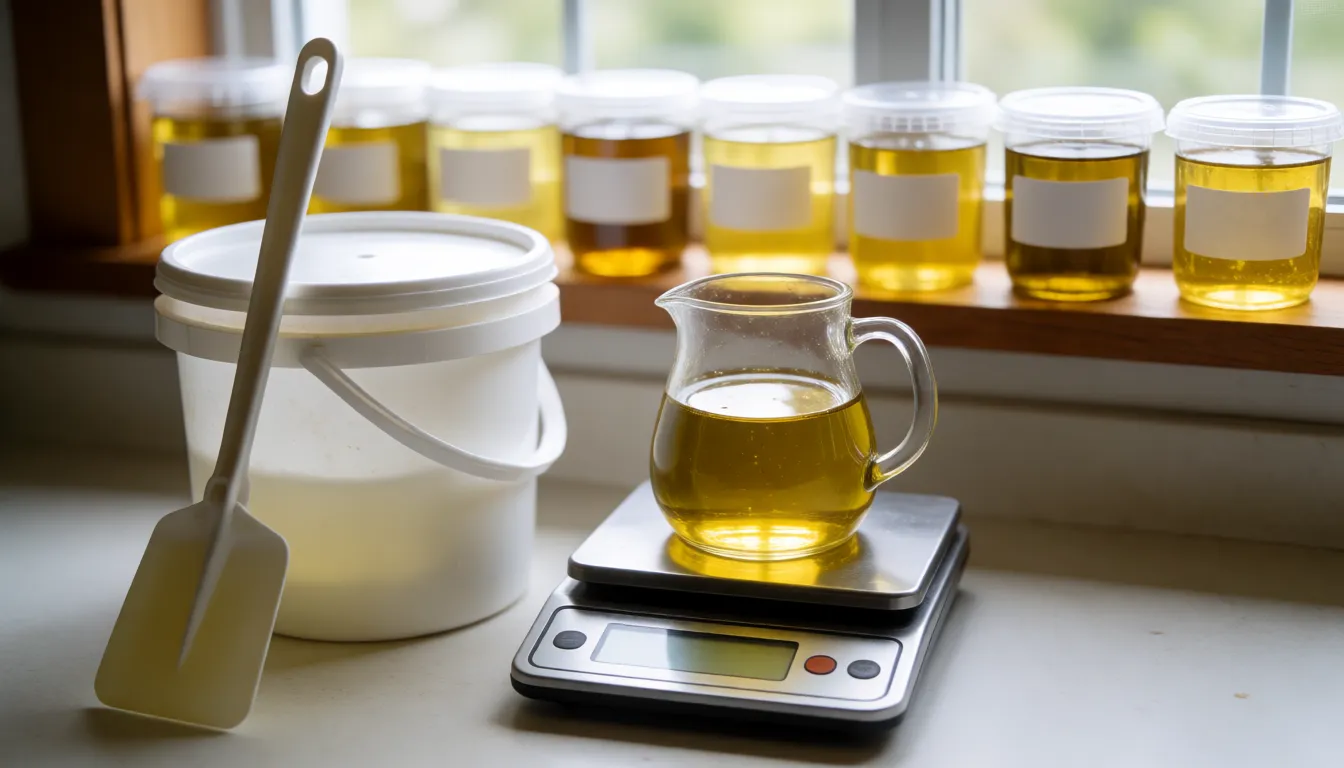
Oils are the easy half. Take a single-batch recipe you already trust, multiply every oil by the number of batches you want to blend, weigh each oil into a lidded bucket, and mix thoroughly.
Here's a sample master batch: four batches of a simple 1,000 g recipe. It's a plain bar recipe I like for a first master batch, and it's scalable: change the totals and keep the percentages.
| Oil | Grams | Percent |
|---|---|---|
| Olive oil | 2,000 g | 50% |
| Coconut oil | 1,000 g | 25% |
| Shea butter | 800 g | 20% |
| Castor oil | 200 g | 5% |
| Total | 4,000 g | 100% |
One batch out of the bucket is 1,000 g: 500 g olive, 250 g coconut, 200 g shea and 50 g castor. Run that total through the lye calculator to get L and W, then use the dilution math above. If you want to see what each oil does before you swap in your own, there's a rundown at soap making oils and what each one does.
A few habits keep the bucket usable:
- Stir well before every pour. Solid oils like coconut and shea settle out of the liquid ones, so the top of the bucket isn't the same recipe as the bottom. If the bucket has set up in a cool room, warm it gently until it's liquid, then stir.
- Weigh out of the bucket, don't measure by volume. Put your pitcher on the scale, tare it, and pour to the weight your recipe needs. Blended oils don't weigh what you'd guess per cup.
- Keep delicate oils out. Oils with a short shelf life, like sunflower, hemp, rice bran or anything you'd worry about going off, go in at the bench for each batch, not in the bucket.
- Store it cool and sealed. Oils can turn rancid or gummy. I try to use a bucket up within a couple of months, and I give it a sniff before I pour. If it smells off, it's not a soap oil anymore.
- Leave fragrance and essential oils out entirely. A safe rate differs from oil to oil, so use your supplier's recommended rate for that specific oil. To turn it into grams, multiply your batch's total oil weight by the rate: for a 1,000 g oil batch with a supplier rate of X%, that's 1,000 × X ÷ 100 grams. Weigh it in at the bench, right before the pour.
If you're looking for a recipe to start with, the beginner trinity bar and classic castile soap are both good candidates for master batching, and more are at cold process soap recipes.
Troubleshooting: crystals, a weak solution and separated oils
| Problem | Likely cause | How to check | Fix |
|---|---|---|---|
| Crystals in the lye jug | Storage got cold (below about 60°F/15°C) | Solid bits on the bottom or sides of the jug | Warm the sealed jug in a warm water bath until clear, open with full gear, and mix before measuring. Move it somewhere room temperature. |
| Weak solution, soft bars, white crust around the cap | Air got in, and the lye absorbed CO₂ and turned partly to carbonate | Check the date, look at the cap for crust, and see if recent soap has been soft or slow to set | Retire the jug and mix a new one. Don't top up an old jug. Use a screw cap that seals fully. |
| Oils separated, with a layer of solid fat on the bottom or a liquid layer on top | Solid oils settle over time | Look at the bucket: is it layered? | Warm gently until liquid, stir thoroughly, then weigh out. |
| Oil smells off or feels gummy | Rancidity or age | Sniff before pouring | Toss it. Next time, use it up sooner and keep it cooler. |
If your finished soap is misbehaving and you're not sure why, Cold Process Soap Problems: What's Wrong and How to Fix It walks through the common culprits.
Master batch shelf checklist
- HDPE jug with a #2 triangle and a screw cap, filled no more than 80%
- Label with contents, "1:1 lye solution", mixing date and a plain warning, on the jug and the cap
- A spot at room temperature, out of reach of kids and pets
- Distilled water on hand for the extra-water step
- A scale for weighing everything, no scoops
- A lidded bucket for your oil blend, with a paddle or spoon that stays with soap gear
- Delicate oils and all fragrance kept out of the buckets and added at the bench
- A review date on the calendar: about three months for the lye jug, and a sniff check before every oil pour
More from the blog
- What Is Saponification? How Oil and Lye Become Soap
- How to Make Liquid Soap: KOH Paste, Dilution, Fixes
- How to Make Breastmilk Soap: Melt and Pour or Cold Process
- Essential Oils for Soap Making: Rates, Picks and Fixes
- Soap pH: What's Normal, Why It's Alkaline, How to Test
- Tallow Soap Recipe: A Hard, Long-Lasting Cold Process Bar
- All posts →