Guides
Soap Calculator Numbers Explained: What to Trust
By The Soap Brain Team — Cold-process soap makers & formulators
·

Your calculator's results page holds two kinds of numbers, and they deserve different levels of trust. The lye amount, superfat and water settings are inputs that decide whether the batch saponifies correctly and safely. Hardness, cleansing, conditioning, bubbly, creamy, iodine and INS are predictions of how the bar will behave, and they are guidelines. Once you know which is which, the page gets much easier to read. This article goes through it top to bottom, saying what each figure is calculated from and what to do with it.
Two kinds of numbers: inputs you fix and predictions you read
Inputs are the settings that turn a pile of oils into soap: the lye amount, the superfat percentage and the water amount. The lye and superfat determine whether every bit of lye finds oil to react with and whether the bar is safe on skin. Once you've decided on them, treat them as fixed. If you change one, rerun the calculator rather than nudging a number by hand.
Predictions are the quality numbers (hardness, cleansing, conditioning, bubbly, creamy) plus iodine and INS. Each is calculated from the fatty acid makeup of your oils, meaning the building blocks each oil is made of. They estimate how the finished bar will feel and lather. They are useful, but experienced soapmakers ignore some of them, and a number outside the suggested range is a prompt to think, not a failed test.
So spend your attention on the inputs first. Start with the one that scares people most: where the lye figure comes from.
How the lye figure is built from SAP values
Every oil has a SAP value (saponification value): the amount of lye needed to saponify a given weight of that oil. It's published in mg KOH per gram of oil, and it differs from oil to oil because oils are made of different fatty acids. Coconut oil and olive oil need different amounts of lye per gram, which is why you can't reuse a lye figure when you swap oils.
The arithmetic is simple:
- For each oil, multiply its weight by its SAP value. That's the lye needed to saponify that oil completely.
- Add those results across all the oils in the recipe.
- Reduce the total by your superfat percentage (covered in the next section).
Your calculator does this for you, and it gives the lye amount for your own oils at your own weights. Use that figure, not one from someone else's recipe.
One column choice matters here. NaOH (sodium hydroxide) makes hard bar soap. KOH (potassium hydroxide) makes soft or liquid soap. They have different SAP values, because a KOH molecule is heavier than a NaOH molecule, so the NaOH figure for the same oil is about 0.71 times the KOH figure. Make sure your calculator is set to the lye you're actually using. The wrong column gives a wrong amount, and that mistake ruins batches or burns skin.
Since this is the point where you first handle lye, here's the safety block, once:
- Wear splash goggles, gloves and long sleeves. Lye burns skin and can blind.
- Ventilate. Mix near an open window or under a fan. Lye in water heats up fast and gives off fumes for the first minute or so.
- Add lye to water, never water to lye. Adding water to lye can erupt. Use a heat-safe container, not aluminum, which reacts with lye.
- If it splashes, rinse the skin under running water right away and keep rinsing for at least 15 minutes. For eyes, keep rinsing and get medical help.
With that covered, the next setting takes some lye back off the total.
Superfat: the lye discount
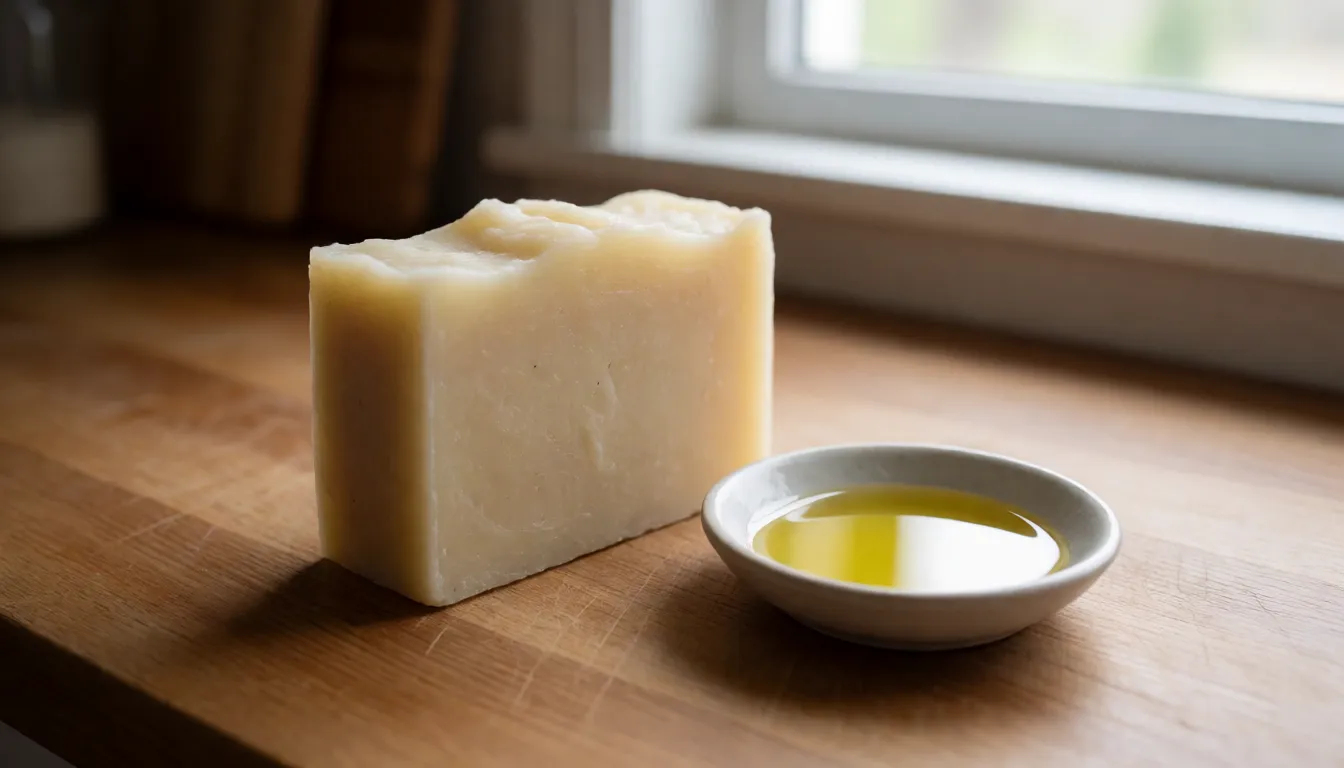
Superfat is the percentage of your oils deliberately left unsaponified. If you set 5%, the calculator reduces the lye so that 5% of the oil weight has nothing to react with and stays in the bar as free oil. Mathematically, the lye total from the SAP arithmetic is multiplied by (100 minus the superfat) over 100.
About 5% is the common standard. Facial bars and extra-gentle bars often go higher, and that's a matter of preference, not a rule. The trade-off is that free oil doesn't clean and can go rancid sooner, so higher isn't automatically better.
Superfat also works as a buffer. If your scale is a little off, the excess oil gives the lye somewhere to go, so a small error is less likely to leave you with lye-heavy soap. But it's a cushion for small errors, not permission to be sloppy. Weigh accurately regardless.
Superfat also explains a quirk on the results page: the quality numbers below don't include it at all.
The quality numbers, one by one
Each quality number is a sum of fatty acid percentages from your oil blend, so once you know which acids go into each, you can predict what an oil swap will do. The ranges below are SoapCalc's targets. The Classic Bells explainer on the SoapCalc numbers covers the same ground if you want a second reference.
Hardness (29–54) adds lauric, myristic, palmitic and stearic acids. It predicts how firm the bar is and how easily it unmolds. It is not a dependable predictor of how long the bar lasts in the shower.
Cleansing (12–22) adds lauric and myristic acids. It reflects how soluble the soap is, including in hard, cold or salty water, and therefore how readily it strips oils. That's why the name misleads. "Cleansing" sounds like a virtue, but a high number means the bar takes more of your skin's natural oils along with the dirt. "Harshness" would be a more honest label. Plenty of people like a bar in the low-to-middle part of the range for that reason, though that is a preference, not a standard.
Conditioning (44–69) adds oleic, ricinoleic, linoleic and linolenic acids. Treat the name loosely. Soap cleans; it doesn't condition the way a lotion does. The number tells you how much of the bar comes from the softer, more unsaturated acids, which tends to mean a gentler, softer bar.
Bubbly (14–46) adds lauric, myristic and ricinoleic acids. It predicts big, fluffy lather.
Creamy (16–48) adds palmitic, stearic and ricinoleic acids. It predicts a denser, more stable lather.
Notice that ricinoleic acid, the main fatty acid in castor oil, appears in both bubbly and creamy. That's why a small amount of castor is a common way to support lather without much affecting the other numbers. Lauric and myristic appear in hardness, cleansing and bubbly, which is why coconut oil pushes all three up together, and why you can't raise one without touching the others.
Some calculators also show a longevity figure, calculated as palmitic plus stearic. Like hardness, it's an estimate of durability, not a measurement.
Two more numbers on the page measure something related: how unsaturated the oils are.
Iodine value and INS
Iodine value measures unsaturation, meaning how many double bonds the fatty acids carry. More unsaturated oils make softer bars, so a lower iodine value generally means a harder bar and a higher one a softer bar. You can find a detailed explanation in the RusticWise article on iodine and INS.
INS is calculated as the KOH SAP value minus the iodine value. It's a single number that tries to summarize bar quality. The usual range is 136–170, with about 160 as the traditional ideal. It's a guideline only. A recipe outside the range can still make a fine bar, and one inside it can still disappoint you, because INS ignores water, superfat and additives.
The last setting on the results page is the water, and it comes in several disguises.
Water: three ways to say the same setting
Calculators let you set water in one of three ways. They all describe the same thing: how much water the lye gets dissolved in.
- Water as a percent of oils: water weight divided by oil weight. Water at 33% of oils means a third as much water as oil.
- Lye concentration: lye as a percentage of the lye-plus-water solution. A 33% concentration means 33 parts lye to 67 parts water.
- Water:lye ratio: water weight divided by lye weight. A 33% concentration is 67 ÷ 33, or roughly 2:1.
Converting between them is straightforward once you have the lye amount from your calculator. If the calculator says the lye weighs L, then:
- Water at a 2:1 ratio is 2 × L.
- Concentration is L ÷ (L + water). With water at 2 × L, that's L ÷ 3L, or about 33%.
- Water as a percent of oils is water ÷ oil weight × 100.
The third conversion is the only one that needs your oil weight. That's why concentration and ratio don't change when you scale a recipe, while percent of oils depends on the oils you chose. Concentration and ratio only describe how the lye and water relate to each other; percent of oils ties water to the oils. Use whichever the recipe you're following was written in, and let the calculator convert.
Less water means the batter thickens faster and the bar firms up sooner. More water gives you more working time, but the bar takes longer to firm up. The setting doesn't change the quality numbers, which are calculated from the oils alone and never see the water.
What the numbers can't see
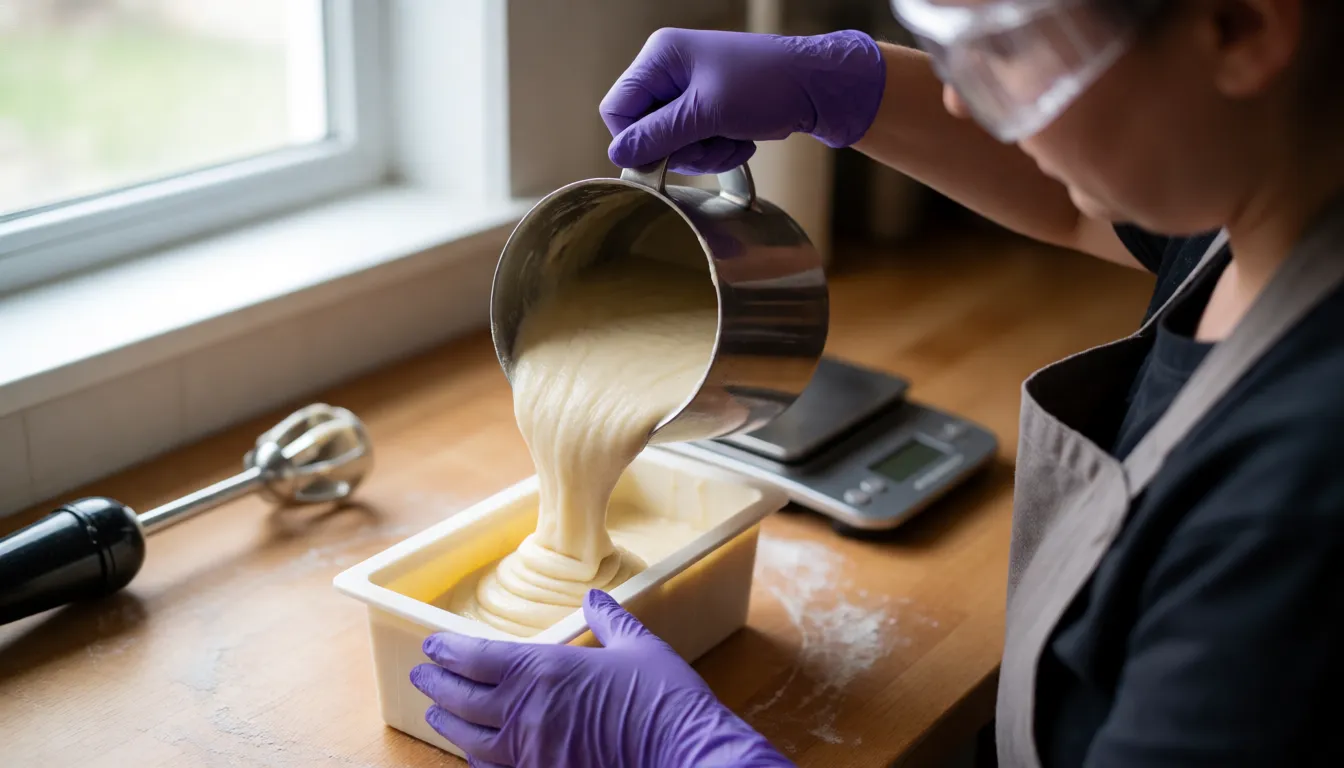
The quality numbers, iodine and INS are all derived from the oils' fatty acids. That leaves out a lot of what actually happens in the pot and on the shelf:
- Superfat. Leaving oil unsaponified changes how the bar behaves, and the numbers don't reflect it. More superfat means more free oil in the bar.
- Additives. Sugar, sodium lactate, salt and milk all affect the bar, but none of them appears in the fatty acid math.
- Water amount. As covered above, it changes how the batter behaves and how fast the bar firms up, and the numbers ignore it.
- Gelling. Whether the batch heats up and goes translucent in the mold changes the finished look and texture.
- Cure time. A bar keeps losing water and hardening for weeks after unmolding. The hardness number describes the recipe, not the bar on day two.
- Water hardness. Your tap water affects how the bar lathers in use, and no calculator can know what's coming out of your faucet.
So a "perfect" set of numbers doesn't guarantee a perfect bar, and a number outside the range isn't a verdict. Keep that in mind the next time one lands outside the range.
Out of range? A decision path
When a number falls outside SoapCalc's range, work through these questions in order:
- Which oil is driving it? Look at the fatty acids. A high cleansing number almost always means a lot of coconut or another lauric-rich oil. A low hardness number usually means the recipe is heavy in soft, unsaturated oils such as olive. The oils guide shows what each oil contributes.
- Swap or shift? You can replace an oil with one that has a similar role, or keep the same oils and change their percentages. Moving 5 points from a lauric oil to a softer one will lower cleansing and raise conditioning, for example.
- Or leave it alone. If the recipe is one you trust and like, an out-of-range number may just be a quirk of how the guidelines are drawn. A castile bar that is nearly all olive oil sits well outside the hardness range and is a classic anyway. The classic castile recipe is a good example of a recipe that ignores the ranges on purpose, and it makes up for the softness with a long cure.
After any change, whether a swap or a percentage shift, rerun the calculator in the Soap Brain lye calculator. Every oil has its own SAP value, so the lye amount changes when the oils change. Never adjust lye by hand to compensate. If you want a starting point that already sits comfortably in range, the beginner trinity bar is a simple place to begin, and the recipe collection has more.
If you run the same recipe through two calculators, you may notice the results don't quite match.
Why calculators disagree slightly
Two calculators can give slightly different numbers for the same recipe because they draw on different SAP data sets and different fatty-acid tables. Oils vary from crop to crop and supplier to supplier, and each calculator's author had to pick a set of values. The differences are small, but they're real.
The practical advice is to pick one calculator for a given recipe and stay with it. Comparing a lye figure from one calculator with a quality number from another is how confusion starts. Run your recipe through a single tool, use its lye amount and its quality numbers together, and rerun it there whenever you change something.
More from the blog
- What Is Saponification? How Oil and Lye Become Soap
- How to Make Liquid Soap: KOH Paste, Dilution, Fixes
- How to Make Breastmilk Soap: Melt and Pour or Cold Process
- Essential Oils for Soap Making: Rates, Picks and Fixes
- Soap pH: What's Normal, Why It's Alkaline, How to Test
- Master Batching Soap: 1:1 Lye Solution and Oil Blends
- All posts →