Guides
Soap pH: What's Normal, Why It's Alkaline, How to Test
By The Soap Brain Team — Cold-process soap makers & formulators
·
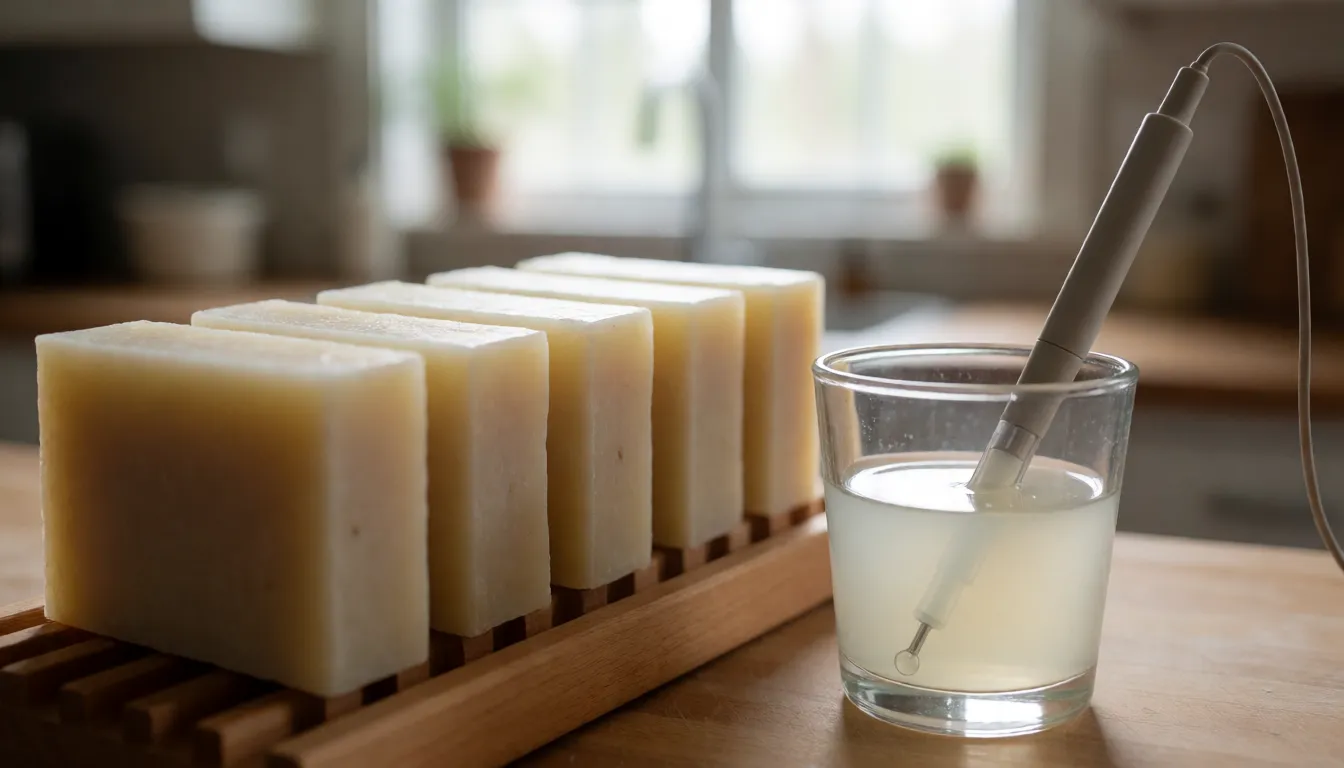
The short version: soap is basic, always. Cured handmade soap usually tests around pH 8-10, a reading above roughly 11 is a reason to investigate, and no true soap can be made skin-balanced. This article covers why that is, how to take a reading you can trust, and what to do with the number.
The short answer
Soap is alkaline (basic). Cured handmade soap is commonly quoted at about pH 8-10. A reading of 10-11 is borderline and often just means the bar is young. A reading above roughly 11 suggests excess lye, and you should stop using the bar until you've checked it.
Skin sits around pH 4-6, often quoted near 5.5, so true soap is always well above skin's range. Products sold as "pH-balanced" are not true soap. The rest of this article gives the reasoning, then a single measurement protocol and a table for interpreting the result.
Why soap is alkaline
Saponification is the reaction between fats or oils and a strong base: sodium hydroxide for bar soap, potassium hydroxide for liquid soap. It produces glycerin and the sodium or potassium salts of fatty acids. Those salts are the soap.
A fatty acid is a weak acid, and the base that made the salt is a strong base. When a salt of a weak acid and a strong base dissolves in water, a small fraction of the fatty acid anions pick up hydrogen from water. That leaves hydroxide ions behind:
R-COO⁻ + H₂O ⇌ R-COOH + OH⁻
So a soap solution is alkaline even when every molecule of lye has reacted. "Alkaline" therefore does not mean "contains lye." A well-formulated bar reads pH 8-10 because the soap itself is mildly basic. The superfat in a recipe (the percentage of oils deliberately left unsaponified, set in the lye calculator) leaves extra oil in the bar and keeps the lye from being in excess. It doesn't turn the soap acidic.
The pH scale is logarithmic. Each whole unit is a tenfold change in hydroxide concentration. Soap at pH 10 and skin at 5.5 are 4.5 units apart, which works out to roughly 30,000 times in hydroxide concentration. That is a large gap, not a small one. It's also why the difference between pH 9 and pH 11 matters: it's a hundredfold change.
What handmade soap should test at
The working range for cured handmade soap is about pH 8-10. Most well-made cold process bars land in it once they've finished curing.
Some castile-type soaps, made mostly from olive oil, are reported to read higher, in the 9-11 range. Treat that as a reason to be careful about method, not as a second normal range. Concentration, the meter, and the age of the bar all move the number, and the protocol later in this article exists to make readings comparable. A reading depends on how you prepared the sample as much as on the soap.
A single number also can't tell you everything. It is a check on the whole batch, not a substitute for running the recipe through the lye calculator before you pour.
Skin pH and what washing does
Healthy skin is mildly acidic, roughly pH 4-6, with about 5.5 the figure most often quoted. This surface layer is often called the acid mantle. The Indian Journal of Dermatology, Venereology and Leprology review of the acid mantle is a good overview of what it does for the skin barrier.
Washing with alkaline soap raises the skin's surface pH temporarily. Skin then recovers toward its baseline over the following hours. For most people with healthy skin, a single wash is not a problem.
Frequency is where it can matter. Repeated exposure to alkaline cleansers can keep the surface pH elevated and slow barrier repair, which is why dermatology sources tend to recommend acidic or neutral cleansers for dry or sensitive skin. That raises an obvious question: can the soap simply be brought down to skin pH? It can't, and the reason is chemical.
Why no true soap is "pH-balanced"
If you try to lower a soap's pH with an acid such as citric acid, the chemistry from earlier runs in reverse. The fatty acid anions pick up hydrogen and become free fatty acids, which do not dissolve in water. By the time you reach skin-range pH, most of the soap has converted back into insoluble fatty acids. The bar stops lathering and cleaning the way soap does, and what's left is closer to a waxy, greasy mixture. "Just add citric acid" doesn't work. Soap is only soap in the alkaline range.
Products that are genuinely near skin pH are made differently. A syndet (synthetic detergent) bar or liquid uses synthetic surfactants rather than fatty acid salts, and those surfactants don't need an alkaline solution to work. Syndets are commonly formulated around pH 5-7.
So a product labelled "pH-balanced" is normally a syndet or a liquid cleanser, not true soap. If handmade cold process or hot process soap is described as "pH-balanced," that claim is wrong, and sellers shouldn't put it in product copy.
A lower pH also doesn't automatically mean a gentler product. Some syndets irritate; some true soaps are comfortable for many people. Formulation matters, not just the number.
The pH 5.5 myth, handled fairly
You'll see the claim that soap has to be pH 5.5 to be safe or gentle. That overstates it. A temporary rise in skin pH after washing is normal and is followed by recovery. How drying a bar feels depends on several things at once: the fatty acid profile of the oils (see what each oil does), the superfat percentage, how thoroughly the soap rinses off, and how often you wash. A high-superfat bar of well-chosen oils can feel gentle at pH 9.
That is not a license to ignore barrier problems. The dermatology position on sustained alkaline exposure holds up: if you have eczema, a compromised skin barrier, or skin that reacts to everyday soap, true soap is not the ideal cleanser. A non-soap cleanser, or plain water or oil cleansing for some areas, is the better choice. Soap pH is one factor. It isn't the whole story, and it isn't nothing.
How to test: methods compared
There are three realistic ways to look at soap pH, plus two that don't work.
pH strips. Cheap and fast, but coarse. They are typically read to about a whole unit, soap can interfere with the indicator dyes, and they often read low. Treat a strip as a rough screen and confirm anything important with a calibrated meter.
Digital pH meter. Far more precise, commonly to a tenth of a unit or better, but only if it is calibrated with buffer solutions and used on a diluted sample in distilled water. Not a dry bar, and not tap water. This is the method the protocol below uses. SoapIndex has a guide to testing soap pH if you want a second walkthrough.
Phenolphthalein drops. Phenolphthalein turns pink from roughly pH 8 upward. Normal soap is above pH 8, so every soap turns it pink. It cannot tell a good bar from a lye-heavy one, so don't rely on it.
Litmus paper. Same problem. All soap is alkaline, so litmus tells you what you already know.
The zap test. A separate, tongue-based screen for free lye, with its own steps and decision rule. It measures something different from a pH number, so it isn't covered here. See How to Zap Test Soap Safely.
Sample preparation and protocol
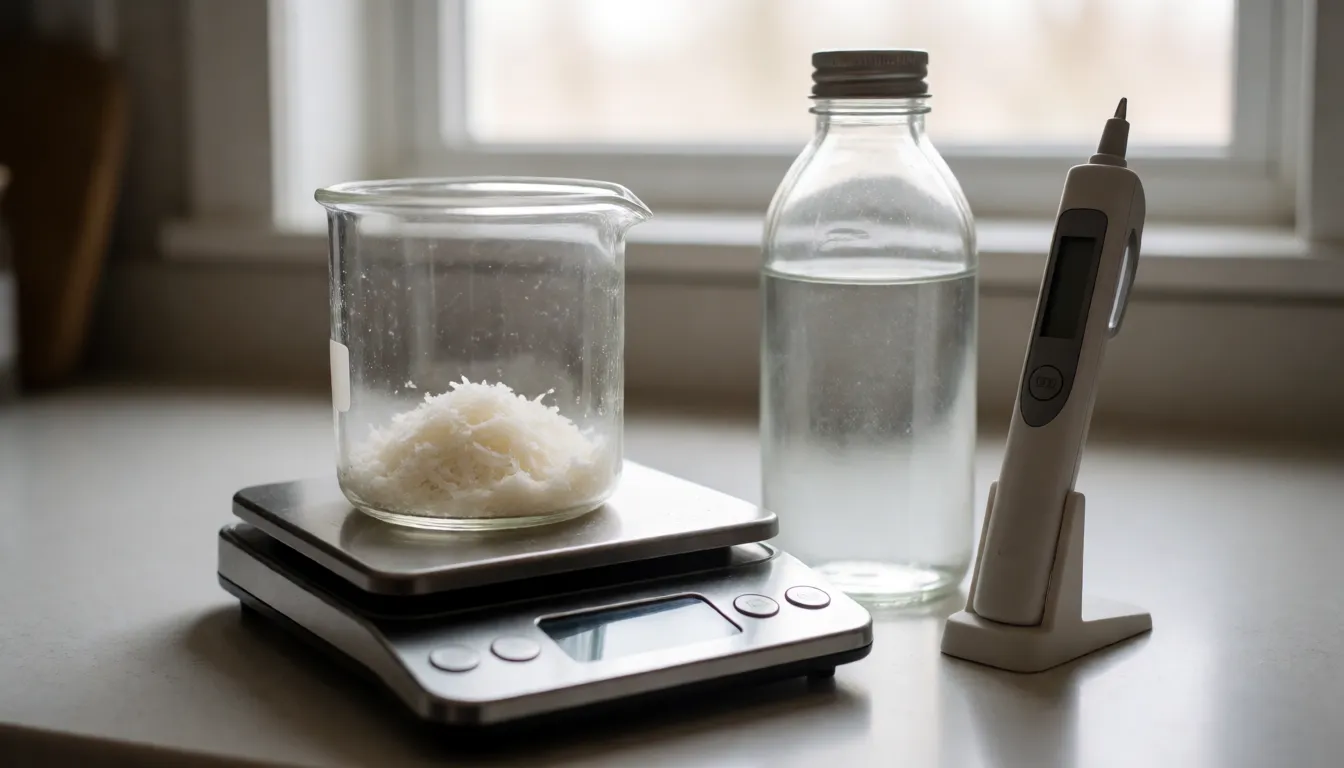
Sources disagree on dilution: some use 1 g of soap in 10 mL of water, others use a 1% solution. Readings shift with concentration, so this article picks one and asks you to stick with it. Use 1 g of grated soap in 99 g of distilled water, a 1% solution by weight. Whichever ratio you use, use the same one every time so results compare across batches.
You need a scale that reads to 0.1 g. At these quantities, a kitchen scale that jumps by whole grams won't give a usable 1% solution.
- Wear gloves and eye protection. Grated soap that is still young can be caustic. If any splashes on skin or in your eyes, rinse with plenty of water right away. For anything more serious, see Lye Burn First Aid.
- Grate a sample from inside the bar, not just the surface, and weigh out 1.0 g.
- Weigh 99 g of distilled water into a clean glass or plastic container. Distilled water matters because tap water has its own minerals and buffering.
- Add the soap and stir until it dissolves. Warm water helps, but let it come back to room temperature before you read it, since temperature affects the result.
- Calibrate the meter before each session using buffer solutions. Buffers at pH 7 and pH 10 bracket the range soap falls in.
- Rinse the probe with distilled water before and after each sample, so one sample doesn't carry into the next.
- Put the probe in, let the reading settle, and record it along with the batch, date, and how long the bar has cured.
Timing. Most saponification finishes within a day or two, but the standard cure is about 4-6 weeks, mostly water evaporating and the bar hardening. Young soap can read high. If a fresh bar tests borderline or high, retest after more cure before deciding anything is wrong.
Reading your result
Use the reading as a band, not a pass/fail line.
| Reading | What it usually means | Next step |
|---|---|---|
| Below about 8 | Unusual for true soap. Check the method, the meter calibration, and whether the product is really soap | Recalibrate and retest |
| About 8-10 | Normal range for cured handmade soap | None |
| About 10-11 | Borderline, common in young soap | Retest after more cure |
| Above about 11 | Suggests excess lye | Stop using it, then check the recipe in the lye calculator |
For a high reading, the checks are: did you enter the right oils and weights, the right superfat, and the right lye type (sodium hydroxide for bar soap, potassium hydroxide for liquid)? Was everything weighed rather than measured by volume? See Soap Making: Weigh, Not Volume, for Safe Lye Math. If the bar really is lye-heavy, Lye Heavy Soap: How to Tell, Fix It or Toss It covers what to do with it.
Why readings disagree
If two readings of the same soap don't match, check these before acting on either:
- Concentration. A 1 g in 10 mL sample reads differently from a 1% solution. Mixing ratios between sessions makes results incomparable.
- Temperature. pH changes with temperature, so a warm sample and a cool one won't agree exactly.
- Strip dye interference. Soap can throw off the indicator dye, and strips often read low. A strip and a meter on the same sample can differ by a unit or more.
- Meter drift. Probes drift between sessions. That's why you calibrate every time, and why a stale or dried-out probe gives odd numbers.
- Young versus cured soap. A bar tested at two weeks and again at six can read differently, with the older bar lower. That's expected, not a fault.
- Sample location. A grating from the surface and one from the center of the bar can differ slightly, especially in a bar that has cured unevenly.
Repeat the reading with a freshly calibrated meter and the same 1% protocol before drawing conclusions.
What to do with your number
- Cured and 8-10: you're done. That is the normal range.
- 10-11, or a young bar: wait, cure it longer, and retest with the same protocol.
- Above about 11, or you're unsure of your method: stop using the bar. Re-enter the oils and superfat in the lye calculator and confirm the lye type and weights against what you actually made. The calculator numbers explained guide covers which figures to trust.
For a separate check for free lye, see the zap test. For what to do with a bar that really is lye-heavy, see Lye Heavy Soap.
More from the blog
- What Is Saponification? How Oil and Lye Become Soap
- How to Make Liquid Soap: KOH Paste, Dilution, Fixes
- How to Make Breastmilk Soap: Melt and Pour or Cold Process
- Essential Oils for Soap Making: Rates, Picks and Fixes
- Master Batching Soap: 1:1 Lye Solution and Oil Blends
- Tallow Soap Recipe: A Hard, Long-Lasting Cold Process Bar
- All posts →