Troubleshooting
Cold Process Soap Problems: What's Wrong and How to Fix It
By The Soap Brain Team — Cold-process soap makers & formulators
·
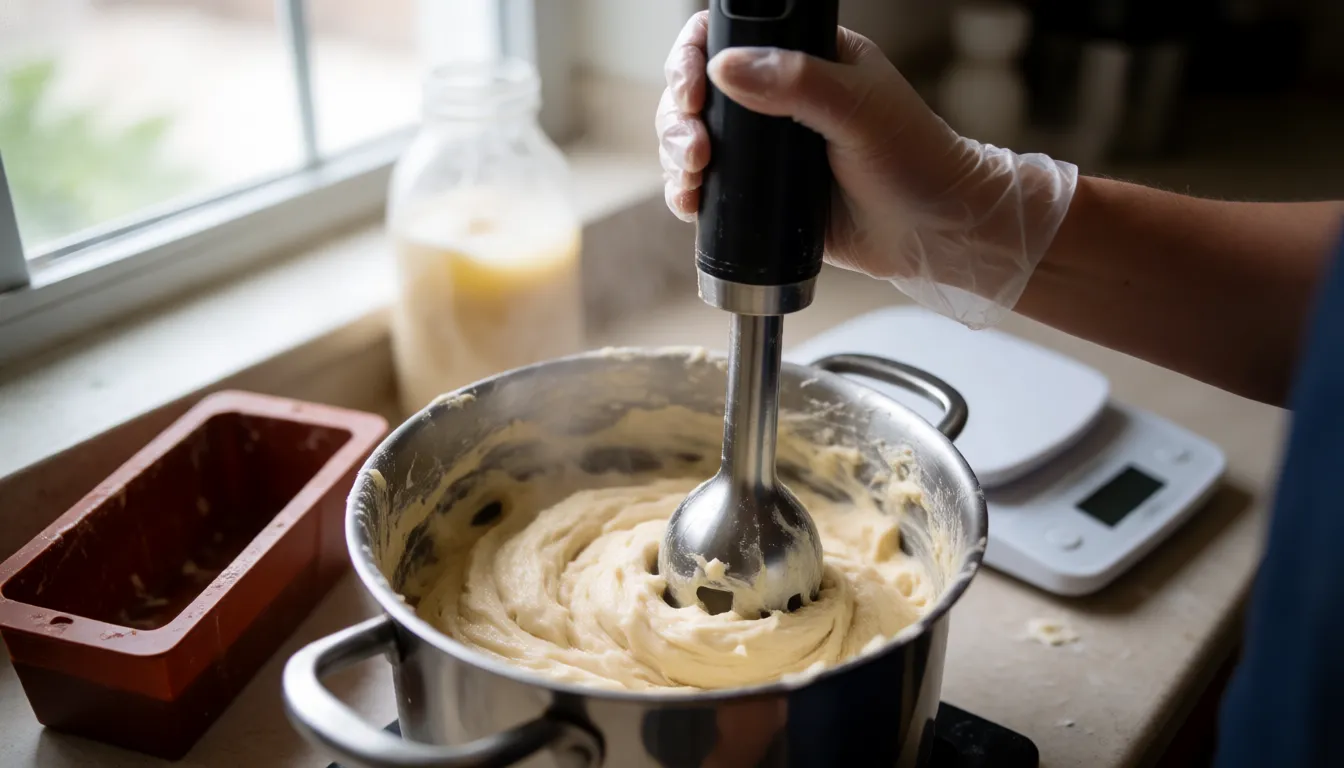
Something's wrong with your soap, and you want to know three things: is it safe, can you save it, and what do you change next time? Start with the table below and the three buckets under it. Most problems turn out to be cosmetic, a few are fixable, and two mean "slow down and check first."
Find your problem: what are you looking at?
| What you see | Most common cause | Where to look |
|---|---|---|
| Batter turns to mashed potato mid-pour | Fragrance or essential oil, plus heat | Seizing |
| Rice-like lumps in the batter | Fragrance, or hard oils cooling too fast | Ricing |
| Batter stays thin forever | Soaping too cold, or just not enough blending | Won't trace |
| Oil pooling on top or in the mold | False trace, or a measuring slip | Separation |
| Cracks, a hot mold, soap erupting over the top | Too hot in the mold | Overheating |
| Translucent jelly-like lines through the bar | Glycerin rivers from heat | Rivers |
| A darker ring or blotchy centre | Partial gel | Partial gel |
| Beads of liquid on the bar | Young soap, humidity, or too much water | Weeping |
| White powdery film | Soda ash | Soda ash |
| Brown or shifting colours | Vanilla in the fragrance, or unstable colourant | Colour changes |
| Orange or brown spots, funky smell | DOS (rancid oils) | DOS |
| Soft, crumbly or sticky bars | Water, soft oils, honey, old lye | Soft bars |
| Weak lather | Recipe balance | Poor lather |
| Zaps your tongue, flaky or crumbly with a harsh feel | Possibly lye-heavy | Lye-heavy soap |
If you want to see how other makers sort the same problems, The Nerdy Farm Wife's troubleshooting guide and Soap Legacy's list of common mistakes are both worth a read.
Is this batch OK? Fine, fixable, or check first
Cosmetic, the bar is fine. Soda ash, glycerin rivers, partial gel, uneven colour and colour morphing. They look odd, but they wash off in the shower like any other soap. Relax, and take notes for next time.
Fixable texture or process issues. Seizing, ricing, no trace, separation, soft or sticky bars, cracking and volcanoing. Some you fix in the pot, some by rebatching, and some by changing the recipe next time.
Stop and check before using. A bar you suspect is lye-heavy, and any wet or weeping bar. Don't use these on your skin until you've checked. Our lye-heavy soap article and our zap test article cover how to check safely, so I won't repeat them here.
Seizing and acceleration
Seizing is when you're stick-blending happily and the batter goes from pourable to a solid lump in about ten seconds. I've had a pot go from silky to "spoon standing upright" before I finished saying a rude word. The top cause is fragrance or essential oil. Some scents accelerate soaping like they're late for a train. High soaping temperatures and a recipe heavy on hard oils make it worse.
How to tell it's the scent: make a small unscented test batch of the same recipe. If it behaves, your fragrance is the culprit.
Rescue mid-seize: work fast. Spoon or scrape the batter into the mold, tap the mold on the counter to knock out air pockets, and smooth what you can. It looks rough, but it's still soap. It'll just be a rustic bar.
Next time:
- Soap cooler, toward the low end of the range in the temperature tug-of-war.
- Add the scent at light trace, not before.
- Blend in short bursts and finish by hand.
- Check your supplier's notes on that scent. Some are known accelerators.
If you actually want a fast-moving batter, our salt bar soap recipe is built around that.
Ricing
Ricing means little rice-like lumps of soap in otherwise liquid batter. Usually it's a scent, or hard oils that started to firm up before everything was emulsified.
Here's what I do, in order:
- Stick-blend in short bursts. Most ricing smooths out right here, and if it does, carry on as normal.
- If lumps are still there after a minute or so of blending, pour the batter through a strainer into a clean container.
- Throw the lumps in the trash. Don't press them into the mold, and don't try to blend them back in, because they're the bit that never emulsified.
- Pour the strained batter back into the pot and blend to light trace. Then pour it into the mold like any other batch.
If the ricing keeps happening with one particular fragrance, that's your answer for future batches: add it later, cooler, and mix by hand.
Won't trace, false trace and separation
Won't trace. Trace is when the batter thickens enough that a drizzle leaves a faint trail on the surface. If you're twenty minutes in and it's still like thin milk, the usual culprit is soaping too cold, below about 70°F. Warm the pot gently in a sink of warm water and keep blending in short bursts. Next time, use the temperatures in the tug-of-war section.
False trace. Melted hard oils can cool and thicken in the pot, and it looks like trace when it isn't. Wait 20-30 seconds without stirring. If it thins out, or oil starts to pool at the edges, it's false trace. Keep blending.
Separation. If the batter has been poured and you see oil pooled on top, or greasy pockets in the mold, you've got one of two things. Most often it's false trace that got poured too early. Sometimes it's a measuring error, like a forgotten ingredient or an unzeroed scale.
If it separates right in the pot, try blending again first. If it's already in the mold, or it stays separated, rebatch it (next section).
Rebatching a separated or soft batch
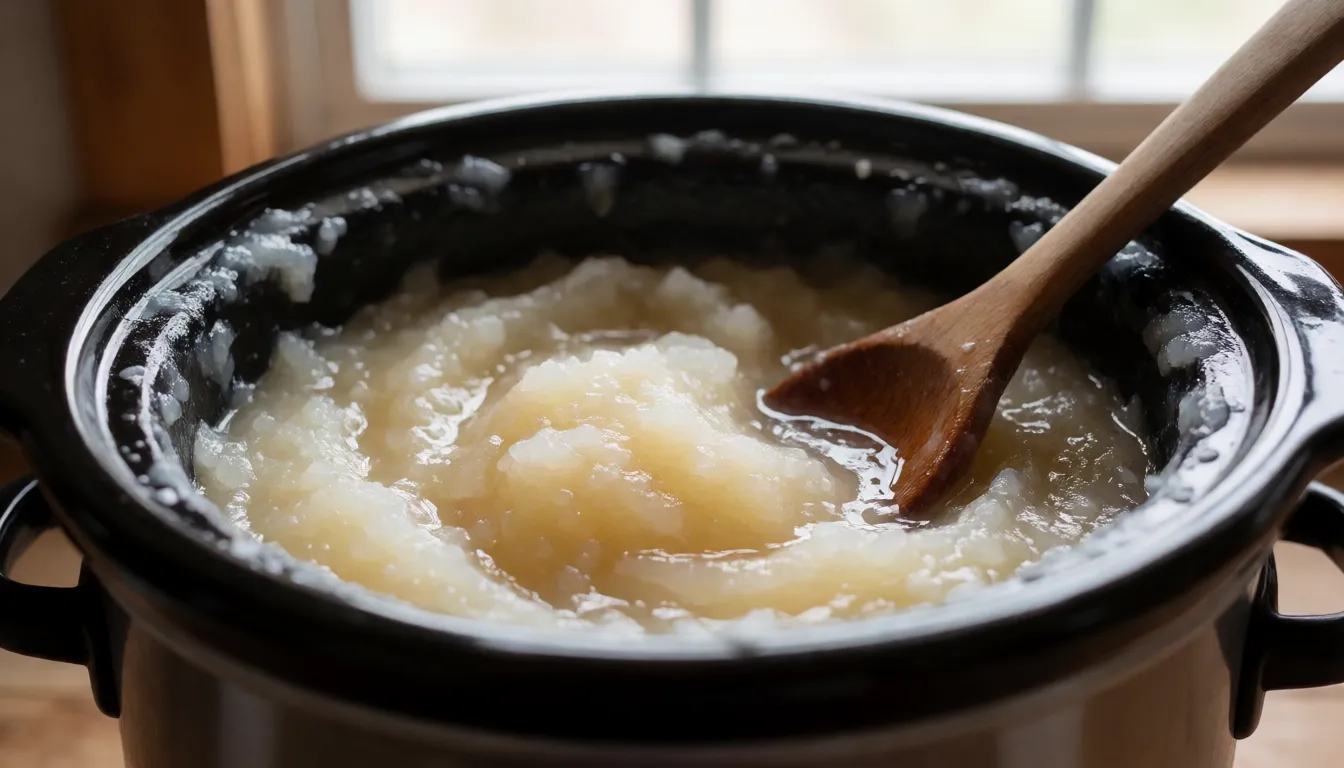
Rebatching means cooking the soap into a workable mass and re-molding it. It rescues batches that separated or stayed soft. It won't fix a badly wrong recipe, and it's not the answer for a suspected lye-heavy bar (see Lye-heavy soap).
Safety, once: uncured soap is caustic. Wear goggles, gloves and long sleeves, and keep the room ventilated. When you mix lye with water, always add the lye to the water, never the other way round. If any splashes on your skin, rinse with plenty of running water.
The steps:
- Chop or grate the soap into small pieces so it melts evenly. If it's still soft in the mold, wait until it's firm enough to lift out (usually a day or two).
- Put it in a slow cooker and add distilled water: about 30 g per pound (450 g) of soap. That's my starting point for soap that looks dry. If the batch separated and is greasy rather than dry, try it with no extra water first.
- Set the cooker to low, which puts the soap at roughly 170-200°F, and put the lid on.
- Stir every 10-15 minutes. Expect it to take 45-90 minutes to turn translucent and look like thick mashed potato. If it's stiff and crumbly at the 30-minute mark, stir in another 10 g of distilled water at a time, no more than that.
- If you want fragrance, let the mass cool for a few minutes off the heat, then stir it in at your supplier's recommended rate for that oil.
- Press it into the mold with a spatula, packing it down to knock out air pockets.
- Let it firm up for 24 hours, then unmold and cut.
- Cure the bars for 3-4 weeks on a rack somewhere dry and airy before using them.
The result is rustic and lumpier than a fresh pour, but it's still good soap. If you need to change the recipe because the batch was soft or separated, don't just add oil to a rebatch. Rerun the whole recipe through the Soap Brain lye calculator and make a fresh batch.
Overheating, cracking and volcanoing
If your mold feels like a hot water bottle, the soap is overheating. Soap heats itself as it saponifies, and if it gets much above about 120°F, you get cracks down the middle or, worse, a volcano where soap erupts over the top of the mold.
In the moment: move the mold somewhere cool, take off any lid or insulation, and put it in a fridge or freezer for a few hours if it's really hot. The soap will still be usable, cracks and all.
Next time:
- Soap cooler.
- Skip the thick blanket.
- Add a water discount (see glycerin rivers for the setting).
- Watch out for sugar, honey and milk in the recipe, which all raise the heat.
The temperature tug-of-war
Here's the plain truth: you can't fix everything with temperature, because it pulls both ways.
- Warm helps soda ash and partial gel.
- Cool helps glycerin rivers, cracking and volcanoing, and seizing.
So you pick your battle. Keep your lye solution and oils within about 10°F of each other. A beginner-friendly window is 95-110°F, and my middle-ground starting point is 100-110°F, with a mold that's lightly insulated but not buried. From there:
- If your bars get soda ash or partial gel, nudge warmer, up to 110-120°F, and insulate evenly.
- If they crack, get rivers or seize, nudge cooler and insulate less.
Change one thing at a time and write down what happens.
Glycerin rivers, partial gel and uneven colour
These are all cosmetic, and the bar is fine to use.
Glycerin rivers are translucent, jelly-like lines through the bar. They come from heat. Prevent them by soaping cooler, using a water discount of 10% or more, using less titanium dioxide and mixing it in well, or putting the mold in the fridge or freezer for a short spell after pouring.
Partial gel is when the centre of the bar heats up and turns translucent while the edges don't, giving a darker ring or blotchy look. There are two ways to fix it next time: soap warmer, around 115-120°F, with even insulation on all sides, or force full gel by putting the mold in a warm oven within 24 hours of pouring. If you'd rather avoid gel entirely, take the cooler approach and put the mold in the fridge.
Uneven colour usually goes along with partial gel, so the same fixes apply.
The water discount setting: in the Soap Brain lye calculator, set a water discount of 10% (or a higher lye concentration). The calculator turns that into actual weights for your oils.
Weeping and sweating bars
If your bar has beads of liquid on it, treat it as "wait and check," not as "fine." A young bar can weep for several reasons: humid air, sugars or glycerin drawing moisture, too much water, or a recipe problem. While the bar is young, that liquid could be caustic.
Don't wipe it with bare hands, and don't use the bar. Let it sit in a dry, airy spot for a few days. If it stops weeping and firms up, cure it normally. If it keeps weeping, or you suspect a measuring error, go to our lye-heavy soap article and our zap test article before you use it.
Soda ash
Soda ash is a white, powdery film on the surface. It's harmless: just the top of the soap reacting with carbon dioxide in the air. It's cosmetic only, and it washes off.
Remove it:
- Wipe it with a damp cloth.
- Shave it off with a vegetable peeler.
- Steam it away with a garment steamer held a few inches off the bar.
Prevent it:
- Soap on the warm side (see the tug-of-war).
- Use distilled water.
- Cover or insulate the mold.
- Use a water discount of 5-10%.
Colour changes: vanilla browning and colour morphing
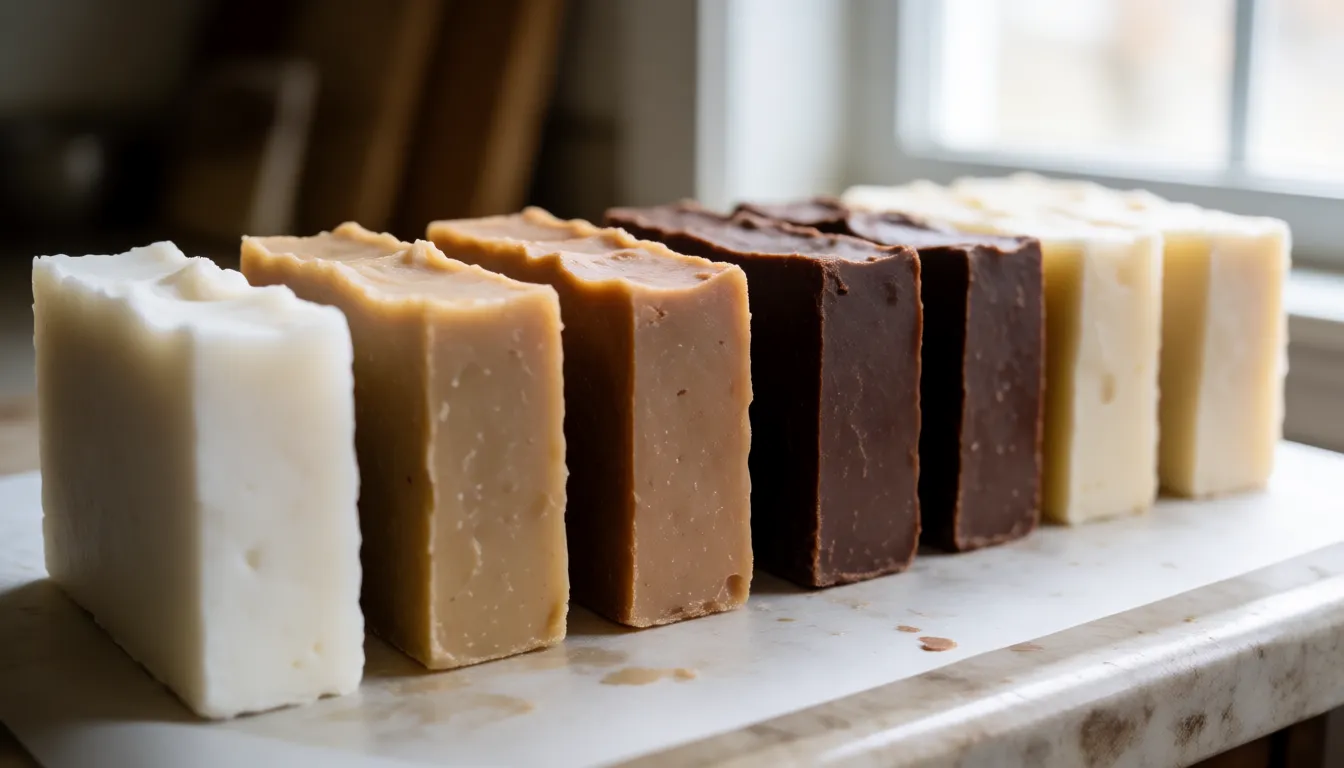
Vanilla browning. Many fragrances contain vanilla, and vanilla darkens soap over the weeks, from cream to tan to chocolate brown. It's cosmetic and expected. If you want a pale bar, choose a fragrance that's labelled as non-discolouring, or plan for brown and lean into it.
Colour morphing. Some colourants shift once they meet lye: a purple that turns grey, a pink that goes beige. It's cosmetic. Test any new colourant in a small batch and cut it open before you commit to a big pour.
Uneven colour is covered under partial gel.
Orange spots (DOS)
DOS, or "dreaded orange spots," shows up after cure as orange or brown spots, sometimes with a smell like old crayons or stale oil. It's oxidation. The usual culprits are oils that were already going rancid, a recipe heavy in polyunsaturated oils like sunflower, grapeseed or hemp, and poor storage of the oils or the finished bars. A high superfat often gets the blame too, but Kevin Dunn's controlled test found 0% and 10% superfat olive oil bars held out equally long, so I don't lean on a low superfat to prevent it.
Prevent it:
- Buy fresh oils and use them in reasonable time.
- Store them cool and dark.
- Keep polyunsaturated oils like sunflower, grapeseed and hemp to a small share of the recipe.
- Keep finished bars somewhere dry and airy while they cure.
- Consider rosemary oleoresin extract at 0.1% of your oil weight. That's my working figure.
Be honest with yourself: DOS is mostly about smell and looks. A bar with a few spots that smells fine is usable. If it smells off, it's your call, and mine would be the bin. There's no shame in it.
Soft, crumbly or sticky bars
The usual causes:
- Too much water.
- Too many soft oils.
- Expired lye.
- Too much honey. I keep it to about 1 tsp per pound of oils at most.
Fixes:
- Use a water discount: in the Soap Brain lye calculator, set a higher lye concentration.
- Use more hard oils. The oils guide shows what each one does.
- Add sodium lactate. I use 1 tsp per pound of oils (about 450 g), stirred into the lye water once it has cooled down, before it goes into the oils. It firms the bar so it's easier to unmold and cut.
- Cure longer.
Cure times: 4-6 weeks is standard. For soaps with a lot of soft oils, give them 3+ months. Soft bars from a batch that separated can go through a rebatch, as above.
Poor lather
If your bar cleans fine but the lather is thin, the recipe's balance is the lever.
- Coconut oil gives big, bubbly lather, but too much can be drying.
- Castor oil adds creamy, stable bubbles.
- Sugar and honey boost lather, but they heat the batter, so go easy.
- Milk makes for creamy lather. Watch the heat.
Change one lever at a time, and rerun every change through the calculator. Our cold process recipes give you tested starting points.
Lye-heavy soap
A lye-heavy bar has more lye than the oils can use, and it can irritate skin. The causes are almost always in how you made it:
- Measuring by volume instead of by scale.
- Not running the recipe through the lye calculator.
- Swapping oils without recalculating.
- A superfat that's too low.
If you suspect it, don't use the bar. Our lye-heavy soap article walks through how to tell, fix it or toss it, and our zap test article covers the check itself.
Next-batch habits that prevent most of this
If you only take one section away, make it this one:
- Weigh everything on a scale accurate to 0.1 oz.
- Run every recipe and every change through the Soap Brain lye calculator.
- Watch your temperatures using the window in the tug-of-war section.
- Change one thing at a time.
- Keep a batch notebook. Write down temperatures, scent, timing and what happened.
If you're still finding your feet, the beginner trinity bar and the classic castile are both forgiving places to practise.
More from the blog
- What Is Saponification? How Oil and Lye Become Soap
- How to Make Liquid Soap: KOH Paste, Dilution, Fixes
- How to Make Breastmilk Soap: Melt and Pour or Cold Process
- Essential Oils for Soap Making: Rates, Picks and Fixes
- Soap pH: What's Normal, Why It's Alkaline, How to Test
- Master Batching Soap: 1:1 Lye Solution and Oil Blends
- All posts →