Safety
How to Zap Test Soap Safely, and What a Zap Means
By The Soap Brain Team — Cold-process soap makers & formulators
·
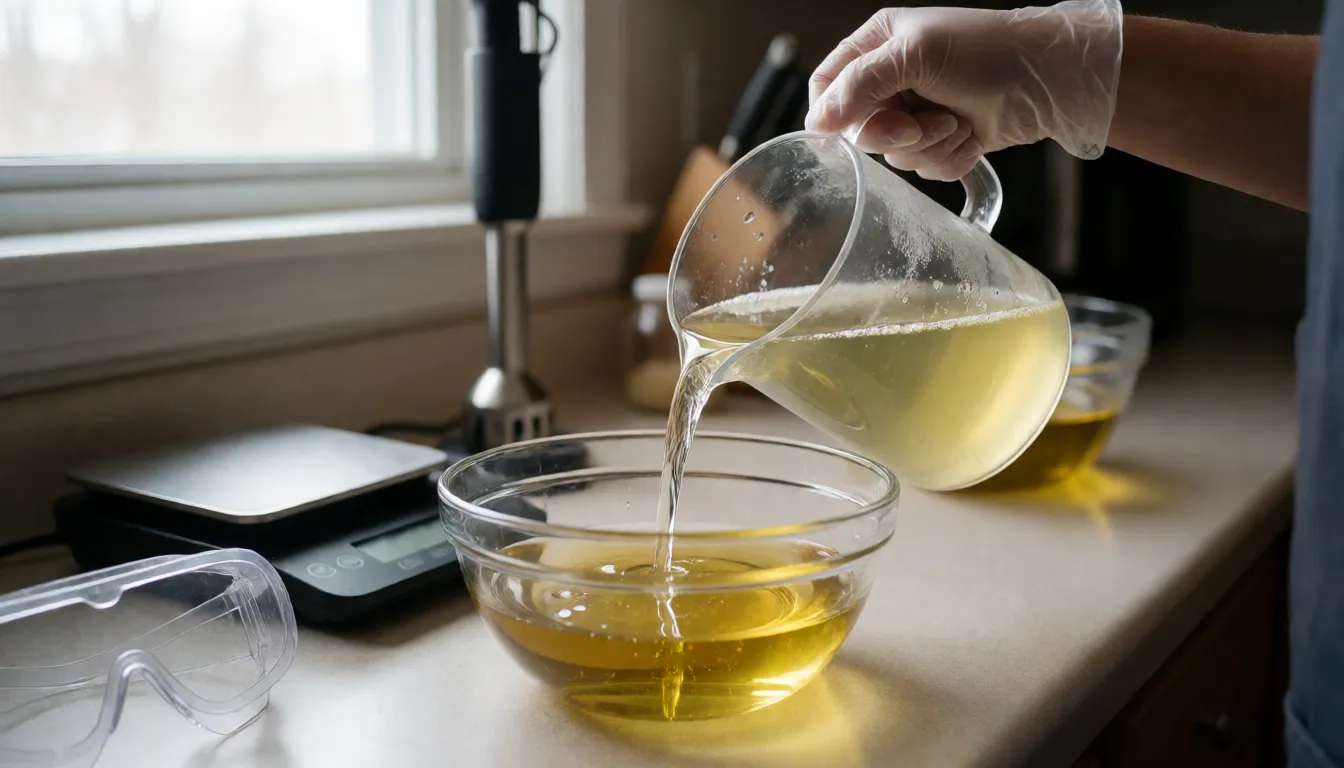
The zap test is a quick check for leftover lye in a finished bar. You wet a fingertip, swipe it across the soap, and touch that fingertip very briefly to your tongue. If the bar contains free lye (sodium hydroxide that never reacted with the oils), you get an immediate sharp sensation, like a static shock or the tip of a 9V battery. Soapy taste is different: flat, bland, a little bitter, with no sting.
It is not harmless. It puts a caustic on mucous membrane, even if only a trace. What keeps the dose small is doing it in the right order: wait until the bar is old enough, touch rather than lick, never test soap that is seeping liquid, and rinse with cool water afterward. It is also a screen, not a measurement. It tells you "something is there" or "nothing I could feel," and it can't tell you how much.
If you make only melt and pour soap, you can skip all of this. You never handle lye, so there is nothing to detect. Everyone else, read on.
What the Zap Test Detects: Free Lye
Saponification is the reaction between lye and the fats in your oils that produces soap and glycerin. When it goes to completion, no lye remains, because every molecule of sodium hydroxide has bonded with fatty acids. A zap means some lye is still free. There are two reasons that can happen:
- The reaction isn't finished. A young bar is mostly saponified within a day or two, but the last of the reaction can lag, especially in the center of a thick block.
- There was too much lye for the oils. The bar can never finish because there is nothing left for the extra lye to react with.
The first is temporary and the second is permanent. The zap test alone can't tell you which one you have, which is why timing matters so much.
Before You Test: When to Wait and When Not to Test
Timing. Advice ranges from 2–3 days after making the soap to at least 5. The shorter window works if the bar is firm enough to cut and unmold. The longer one exists to filter out false alarms: a bar that zaps on day two may simply be finishing saponification. A zap that early doesn't prove the recipe is wrong. It only means the test is telling you nothing yet. If in doubt, wait the longer period.
Don't test a bar that is weeping, beading, or seeping liquid. That liquid can be concentrated lye solution, and a touch of it is a much bigger dose than a dry surface.
Protective gear. Wear gloves and eye protection whenever you handle soap that is uncured or that you suspect is lye-heavy. Cut or unmold the bar in gloves. The test itself needs a bare fingertip, so take the gloves off, wash your hands, and use a clean bar that is firm, dry, and past the wait. Never handle raw batter or a soft bar with bare hands to "check" it.
How to Run the Zap Test, Step by Step
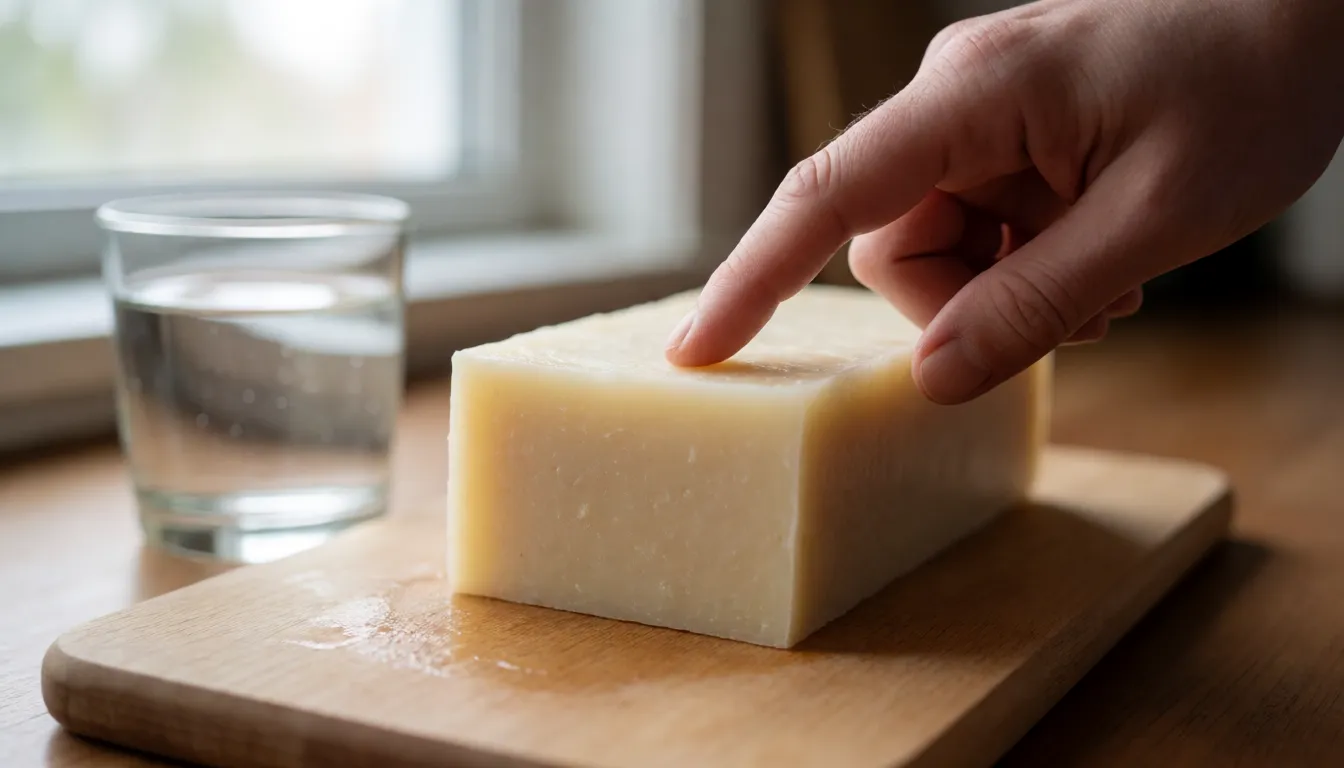
- Cut a fresh face. Slice the bar so you're testing an interior surface. Lye can sit unevenly, and the outside has been exposed to air, which changes its surface chemistry.
- Wash and dry your hands, then wet one fingertip. A clean fingertip means no glove residue or other soap confuses the reading. A damp finger picks up a small amount of soap and dissolves it slightly, so any free lye is in solution where your tongue can detect it.
- Swipe the damp fingertip once across the cut face. One light pass is enough. More soap on your finger means a larger dose and no better information.
- Touch the fingertip briefly to your tongue. Touch, don't lick, and don't lick the bar directly. The point is to sample the smallest amount that would still register.
- Note what you feel right away. A real zap is immediate.
- Rinse your mouth with cool water. Do this whether or not you felt anything, since soap residue is unpleasant and you may have picked up more than you thought.
Reading the Result: Zap, Tingle, or Just Soap
The common scale runs like this, and it is subjective:
- Soapy taste, no sting: no detectable free lye. This is what a well-made bar does.
- Mild tingle: possibly a slight excess of lye.
- Sharp snap or burn: a lot of excess lye.
If you can't tell whether you felt something, you probably tasted soap. A true zap is unmistakable and instant. Don't repeat the test "to be sure" on the same spot. If you felt nothing clearly, you have your answer for that touch, and a second sample only adds exposure.
If Your Soap Zaps: What to Do Next
Right away: spit, then rinse your mouth thoroughly with cool water. Stop testing that bar.
If the bar was young, meaning you tested it inside the early window, set it aside and retest after more days. Saponification may simply have needed more time, and curing (the weeks of drying that follow) also lets water evaporate for a harder bar.
If it still zaps after the longer wait, treat it as lye-heavy. Curing does not remove real excess lye. Extra cure time only helps a bar that was tested too early, so "cure it longer and hope" is not a fix.
Rebatching, meaning melting the soap down and adding oil to use up the extra lye, is often suggested. The limit is that without a measured lye excess, you have no way to know how much oil to add. Guess low and it still zaps; guess high and you get an oily, soft bar. It's an option if you accept that uncertainty and retest, but the default should be discarding the bar. Whatever you decide, the next question is what went wrong.
What Causes a Lye-Heavy Bar
Nearly every cause traces back to the inputs and measurements around your lye calculator:
- A wrong SAP value. The saponification (SAP) value is the amount of lye a given oil needs to fully react, listed for each oil in mg KOH per gram. Potassium hydroxide (KOH) makes soft or liquid soap and sodium hydroxide (NaOH) makes bar soap, and they are not interchangeable. Using a KOH-based figure where a NaOH one belongs, or mixing the two, gives the wrong lye for the oils. A calculator that lets you choose the lye type handles this correctly, so pick carefully.
- A superfat set too low. Superfat is the percentage of oils deliberately left unreacted. The calculator does this by figuring lye for less than 100% of the oils, so a little oil is always in surplus. That surplus is your buffer against small errors, and setting it very low or to zero removes it.
- An oil added, swapped, or re-weighed without recalculating. Every oil has its own SAP value (see what each oil does). Change the oils and the lye requirement changes with them.
- Weighing errors or measuring by volume. Use a scale and measure oils and lye by weight. Volume varies with temperature and how you pour, so it isn't reliable for a formula this sensitive.
One thing that does not cause this is the water-to-lye ratio. Water changes how fast the batter traces and how hard the bar ends up, but the amount of lye the oils need is fixed by the oils and the superfat, not by how much water you use.
What the Zap Test Cannot Tell You
Treat the zap test as one instrument with known blind spots:
- It's a yes/no screen, not a measurement. A mild tingle can't be turned into a percentage of excess lye.
- It's subjective. Taste sensitivity varies from person to person, and "no zap" from one taster is not proof.
- It samples one spot. Lye can sit unevenly in a bar, for example in a pocket from poor mixing, so a clean touch on the edge doesn't clear the middle. This is why you test a fresh-cut face.
- It depends on timing. Too early gives false alarms, and a bar that passes early hasn't necessarily reached its final state.
- It doesn't replace the calculation. The real safeguard is the calculator with the correct SAP values, an accurate scale, and a superfat you chose on purpose. The zap test checks that work; it doesn't stand in for it.
That brings up a better companion check, one that doesn't involve your mouth at all.
pH Meters, Strips, and Other Checks That Skip the Tongue
pH is a scale of acidity and alkalinity, with 7 neutral, lower numbers acidic, and higher numbers alkaline. Soap is alkaline by nature: it's the salt of a strong base (lye) and weak acids (fatty acids), so it always reads above neutral. A high pH by itself is therefore not a failure. What matters is how high, and whether the reading fits a bar that has finished reacting.
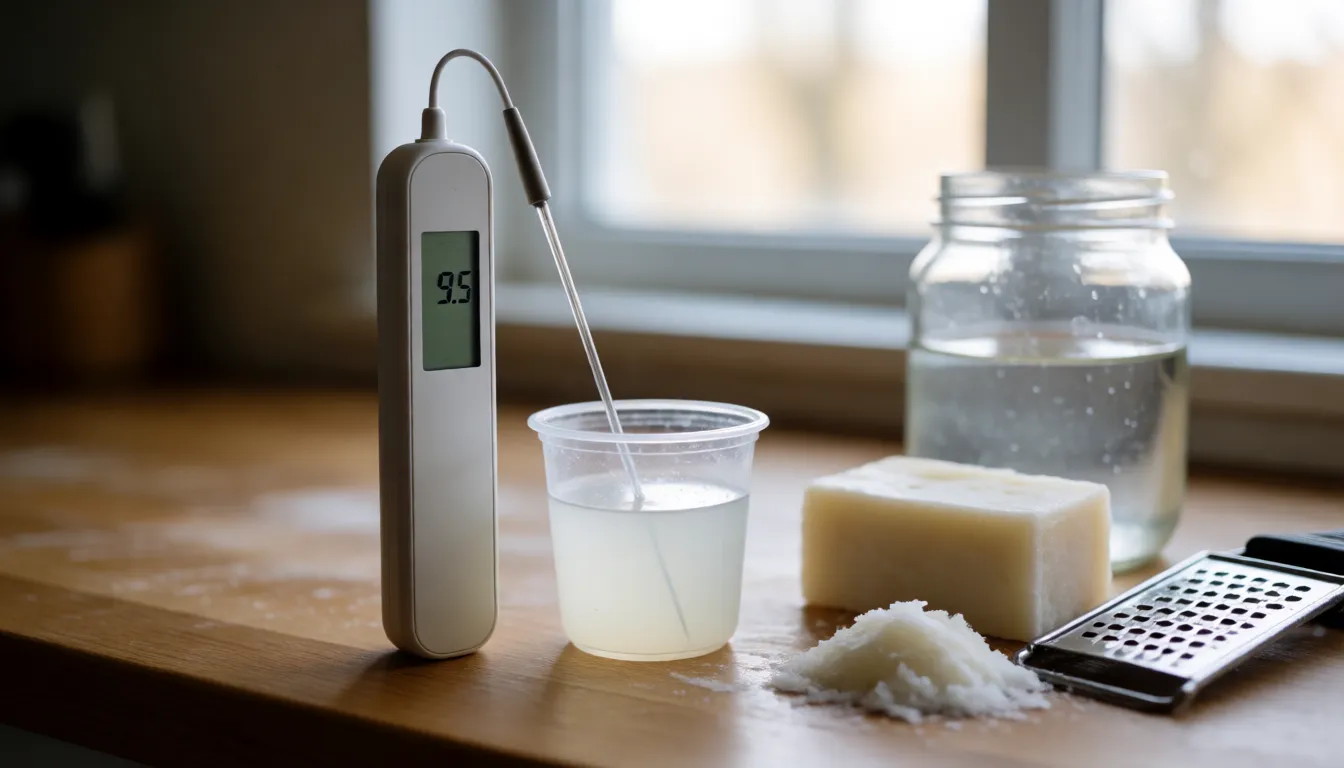
Digital pH meter. This is the most precise option. Grate some soap, mix it into distilled water, and read the slurry with a meter that you have calibrated against buffer solutions. You get a number and no mouth exposure. The Soaply guide to testing soap pH walks through the methods and what the numbers mean.
pH strips. They're cheap, but colors at high pH are hard to tell apart, so they're a rough second opinion. Pool test strips aren't suitable because they don't cover the range you need.
Litmus paper. It only tells you whether something is alkaline. Since all soap is alkaline, it can't distinguish a good bar from a bad one.
The grated-soap dissolution test. This dissolves grated soap in liquid so you can test the solution rather than a bar surface. Soap Legacy's rundown of ways to test soap for lye safety covers this and other methods.
Phenolphthalein. This indicator turns pink above roughly pH 8.2, and normal soap already sits above that. A pink result on cured soap therefore doesn't show excess lye, so it's not a useful test for this question.
That leaves the question of which number is normal.
What pH Is Normal for Cured Soap
The commonly cited range for cured handmade soap is about pH 8–10. Some sources treat higher readings as acceptable, and quoted ranges vary with the recipe and with how the pH was measured, since strips and meters, and different slurry methods, can give different numbers for the same bar. So there isn't a single hard pass/fail line. A reading above the usual range is a reason to look more closely at the bar and the recipe, not proof by itself that the bar is unsafe.
Physical Signs of a Lye-Heavy Bar
Some physical signs point toward excess lye. They are hints rather than proof:
- White spots or crystals on or in the bar.
- A crumbly texture.
- Thin lather that dies quickly.
Other things can cause the same signs. Certain fragrances can accelerate trace or discolor a bar, which muddies what you're seeing. If you use scent, follow your supplier's recommended rate for that specific oil, and convert it to grams by multiplying the rate by your oil weight. None of these signs replaces a check.
A Decision Rule: Screen, Second Opinion, Then Recheck the Recipe
Use the tests in order:
- Zap test as the quick screen, on a fresh-cut face, after the bar has passed the early window. No zap means a soapy taste at most.
- A pH meter or strips as a second opinion, especially if you got a tingle, felt nothing clearly, or want a number without your tongue involved.
- If either check flags trouble, go back to the recipe. Re-enter your oils and superfat in the lye calculator, confirm the lye type and SAP values, and check your scale and weights. A tested bar that passes tells you the last batch was fine; the calculation is what makes the next one so.
If you want to make a batch with a short, easy-to-verify ingredient list to check your process, try the beginner trinity bar, or browse more cold process recipes. For a deeper look at the test itself, Soapy Stuff's zap test page is another reference.
More from the blog
- Lye Safety for Soapmakers: Gear, Airflow, and First Aid
- Lye Burn First Aid: What to Do for Skin, Eyes and More
- Soap Making: Weigh, Not Volume, for Safe Lye Math
- KOH Safety for Liquid Soap: Handling, Paste and Dilution
- Lye Heavy Soap: How to Tell, Fix It or Toss It
- What Is Saponification? How Oil and Lye Become Soap
- All posts →