Safety
Lye Heavy Soap: How to Tell, Fix It or Toss It
By The Soap Brain Team — Cold-process soap makers & formulators
·
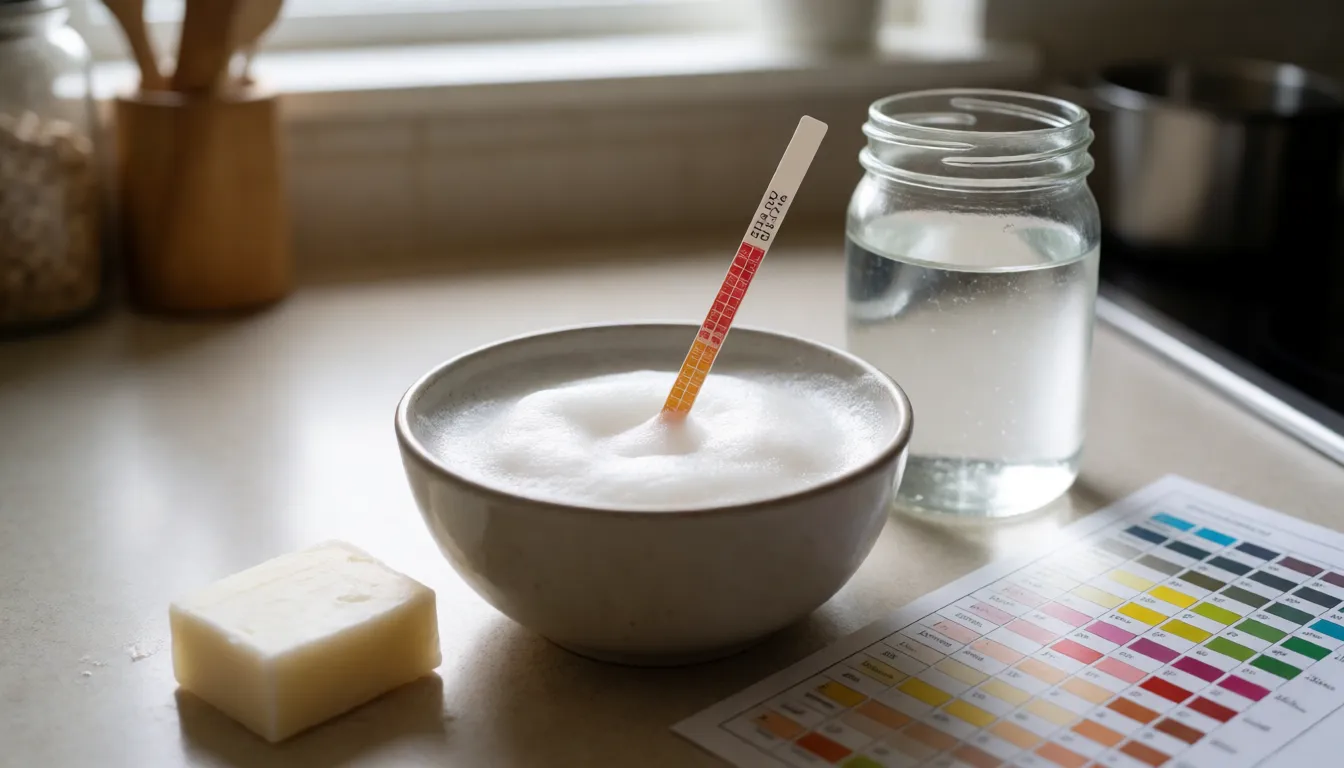
Most bars that seem lye heavy are not. If the soap is under about five days old, wait and retest before you do anything else. If it is older and tests high on a pH strip, it probably has too much sodium hydroxide (lye) for its oils. Whether you rebatch it or throw it out depends on whether you can find out how the excess got there. Curing does not remove genuine excess lye.
Is It Lye Heavy, Young, or Pocketed?
Three different situations look alike at first, and they call for different responses.
Young soap. Saponification is the reaction in which lye and oils turn into soap and glycerin. It is not finished the moment you pour. A bar that zaps at day one or two may simply still have lye to use up. Two to three days is the minimum before testing, and up to five is safer for a young bar or a rebatched one. If it tests fine after that, you are done.
Genuinely lye-heavy soap. There is more sodium hydroxide in the batch than the oils can react with. The extra stays in the bar as free lye, and no amount of curing removes it. This can often be fixed, provided you know roughly what went wrong.
Localized lye pockets. The overall recipe may be correct, but the lye was not mixed in evenly and collected in concentrated spots. The bar can test mild in one place and be caustic a few centimeters away. This is the most dangerous case and the one that usually means discarding, because a test only tells you about the spot you tested.
The rest of this article covers how to tell these apart and what to do about each.
What Lye-Heavy Actually Means
Lye-heavy soap contains free, unreacted sodium hydroxide. Two terms explain how that happens.
The SAP value (saponification value) is the amount of lye needed to saponify one gram of a given oil. Each oil has its own, and calculators list them in mg KOH/g, converting to sodium hydroxide for you. Oils differ because their fatty acids differ, so a batch of coconut oil needs a different amount of lye than the same weight of olive oil. A lye calculator multiplies each oil's weight by its SAP value and adds up the results.
The superfat is the percentage of the oils you deliberately leave unreacted. If you set a 5% superfat, the calculator gives you enough lye to saponify only about 95% of the oils. The remaining 5% stays in the bar as free oil, which makes it milder and more conditioning.
Superfat is your safety margin. A superfat of zero means lye and oil are exactly matched, with no cushion for a small weighing error. Once there is more lye than the oils can consume, the margin is gone. A negative effective superfat means the lye exceeds what the oils can react with, and the surplus is free lye in the bar. So "lye heavy" and "negative effective superfat" are the same problem described two ways, which is why you can size it with the calculator later.
What Causes It
Every cause comes down to the amount of lye not matching the amount and type of oil actually in the pot.
- Weighing errors. A scale that isn't zeroed with the container on it, a misread digit, or a scoop that wasn't level. Small errors matter most in small batches, and they eat the superfat first.
- Mixing up NaOH and KOH. Sodium hydroxide makes bar soap and potassium hydroxide makes liquid or soft soap, and their SAP values differ. Using the wrong one, or leaving the calculator set to the wrong lye type, gives a wrong lye amount for the same oils.
- Wrong SAP values. A hand-typed SAP value, or one copied from a source that lists a different lye type or unit, throws off the whole calculation.
- Swapping oils without recalculating. Replacing one oil with another because you ran out is the classic tweaker's mistake. Different oils have different SAP values, so the old lye amount no longer fits.
- A superfat that is too low. Even a correct calculation leaves little cushion if the superfat is set very low or at zero, so a tiny measuring error pushes the bar over the line.
- Measuring by volume. Cups and spoons vary with oil temperature, how solid a butter is, and how it was packed. Weigh oils and lye on a scale.
Water-to-lye ratio is worth clearing up because it is often blamed. The amount of water changes how fast the batch traces, how soft the bar is at unmolding, and how long it takes to dry. It does not change how much lye the oils need. Too little water can make a batch behave badly, but water alone does not create excess lye.
Signs and How to Confirm Them
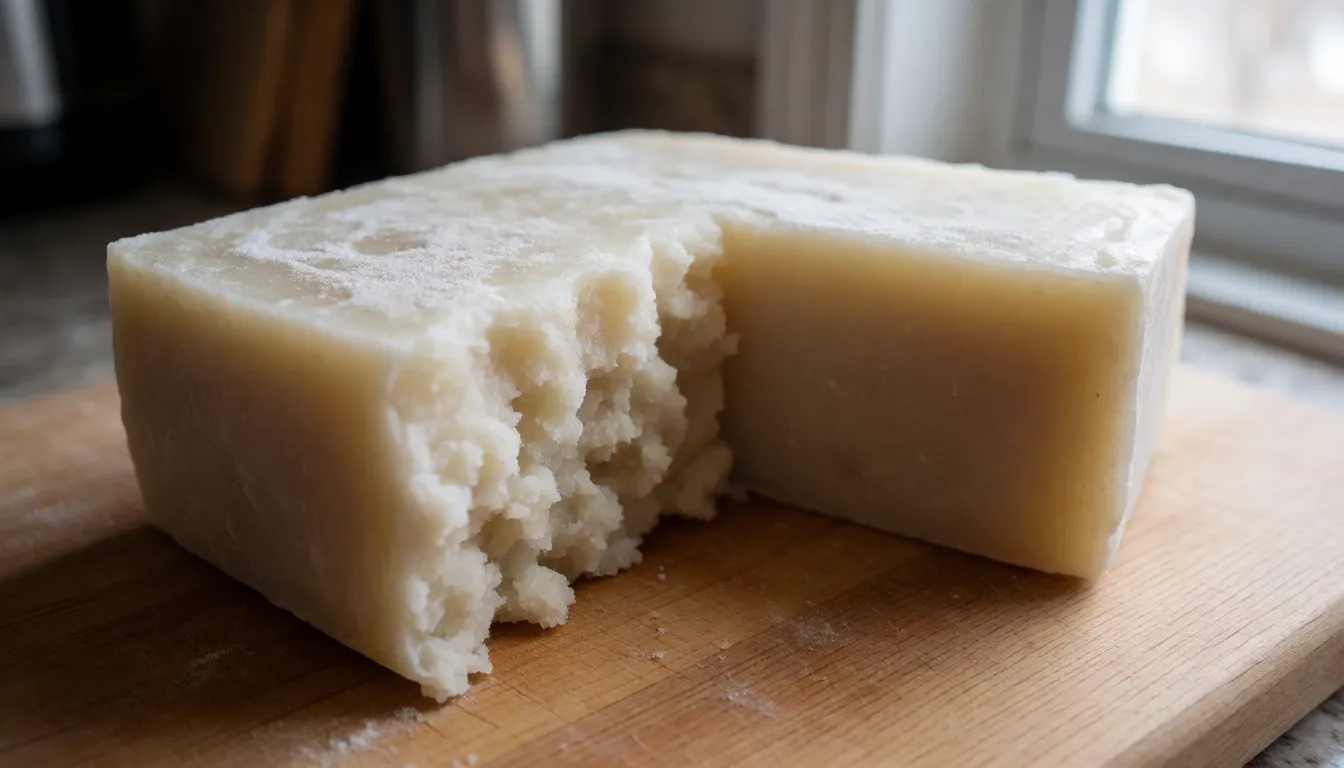
Several signs suggest excess lye: a zap on the tongue, a high pH reading, crumbling, white spots, a waxy or oily look, and a harsh feel on skin. Treat the visual ones as prompts to test, not as diagnoses. White powder is often soda ash, a harmless film of sodium carbonate that forms when the surface of fresh soap reacts with carbon dioxide in the air. Fragrance behavior and other recipe factors can also cause spotting and texture changes, and crumbling and waxiness have several possible causes as well. A bar can look flawless and still be lye heavy, or look terrible and be fine.
The zap test. Dampen a fingertip, swipe it lightly across the soap, and touch it very lightly to your tongue. A sharp sting like a weak battery suggests free lye. Wait until the soap is at least a couple of days old before trying it. It carries a real risk of irritation or injury, so many soapers skip it in favor of pH strips. It has its own dedicated article on this site, and the Soap Legacy guide to testing soap for excess lye compares several methods.
pH strips. This is the check to rely on. pH measures how alkaline something is on a scale where 7 is neutral. To use strips properly:
- Use distilled water, since tap water can skew the reading.
- Wet a piece of the soap and work it into a real lather. Pressing a strip against a dry bar tells you very little.
- Press the strip into the lather and compare it to the chart.
- Use strips made for testing pH in general, not pool-supply strips.
Read the number this way:
| Reading | What it suggests |
|---|---|
| About 8 to 10 | Normal for finished soap |
| 10 to 11 | Gray zone. Investigate; don't call it a pass or a fail |
| About 11 and above | Lye heavy |
The gray zone exists because readings vary with the recipe and the method, and because strips are a rough tool. Higher pH does raise the risk of skin irritation, but there is no single threshold at which a bar becomes unsafe.
Test in more than one spot, retest after a few more days if the bar is young, and treat one reading as a hint, not a verdict. Indicators such as red cabbage juice change color across the whole pH range, and since all soap is alkaline, they cannot tell you a bar is safe. Phenolphthalein turns pink on perfectly good soap, so it can't separate good from bad. Skip both.
Re-running the Numbers to Size the Problem
If you know what you actually put in the pot, the lye calculator can show you the size of the problem. Enter the real weights of each oil as you weighed them, not the recipe's intended weights, and note the lye amount you actually used. Then check the resulting superfat. If the calculator shows a superfat of zero or below, that confirms lye excess and shows roughly how far over you went.
The same re-entry gives you a principled basis for a rebatch. Adding oil to the recipe in the calculator shows how much more oil is needed to bring the effective superfat back up to a reasonable level. This beats a generic "add a spoonful per pound" rule, because oils differ in how much lye they consume, and your batch has its own excess.
The limits matter. This works only if the true weights are known. If you are guessing what you measured, the calculation is guessing too. It also assumes the lye and oil were evenly mixed, so it says nothing about pockets. And it does not tell you the pH: use the number to plan the fix, then confirm with strips.
Fix It: Rebatching Step by Step
Rebatching means melting the soap back down so you can add oil to it. Adding oil to a solid bar does nothing, because the free lye is locked inside the bar. Melting it with a little water dissolves the lye and lets it meet fresh oil, and heat and thorough mixing drive the reaction. Extra oil reacts with leftover lye only under those conditions.
Safety, once. Wear gloves and goggles, work in a ventilated space, and never taste the soap to check it. If soap paste splashes on skin, rinse under running water. If it gets in your eyes, flush them with water and get medical help.
- Grate the soap finely. Wear gloves. Small shreds melt faster and more evenly.
- Melt with a little distilled water. A slow cooker on low is the usual choice. Use only as much water as it takes to get the soap moving.
- Add oil gradually. Add small amounts, using your calculator re-run to estimate the total needed. Stir thoroughly after each addition, and cook and stir for a while (about 15 minutes) before adding more. A stick blender helps the oil combine.
- Retest. Wait for the batch to cool, then test a small sample with a pH strip. Stop adding oil when the pH comes into the normal range.
- Mold. Press the soap into the mold while it is still hot and workable.
- Wait and cure. Let it set, then wait a few days (up to five) before testing again, and allow a typical cold-process cure of about four to six weeks.
Two details help. If the mixture foams up, stir it down and lower the heat. And too much added oil makes a soft, greasy bar, which is why you add it in increments rather than all at once.
Rebatching fails when the lye was unevenly distributed, when you can't verify the result, or when the pH stays high after repeated additions. For other perspectives, see Soap Startup on fixing soap with too much or not enough lye and Elly's Everyday on rebatching a lye-heavy soap.
When to Discard
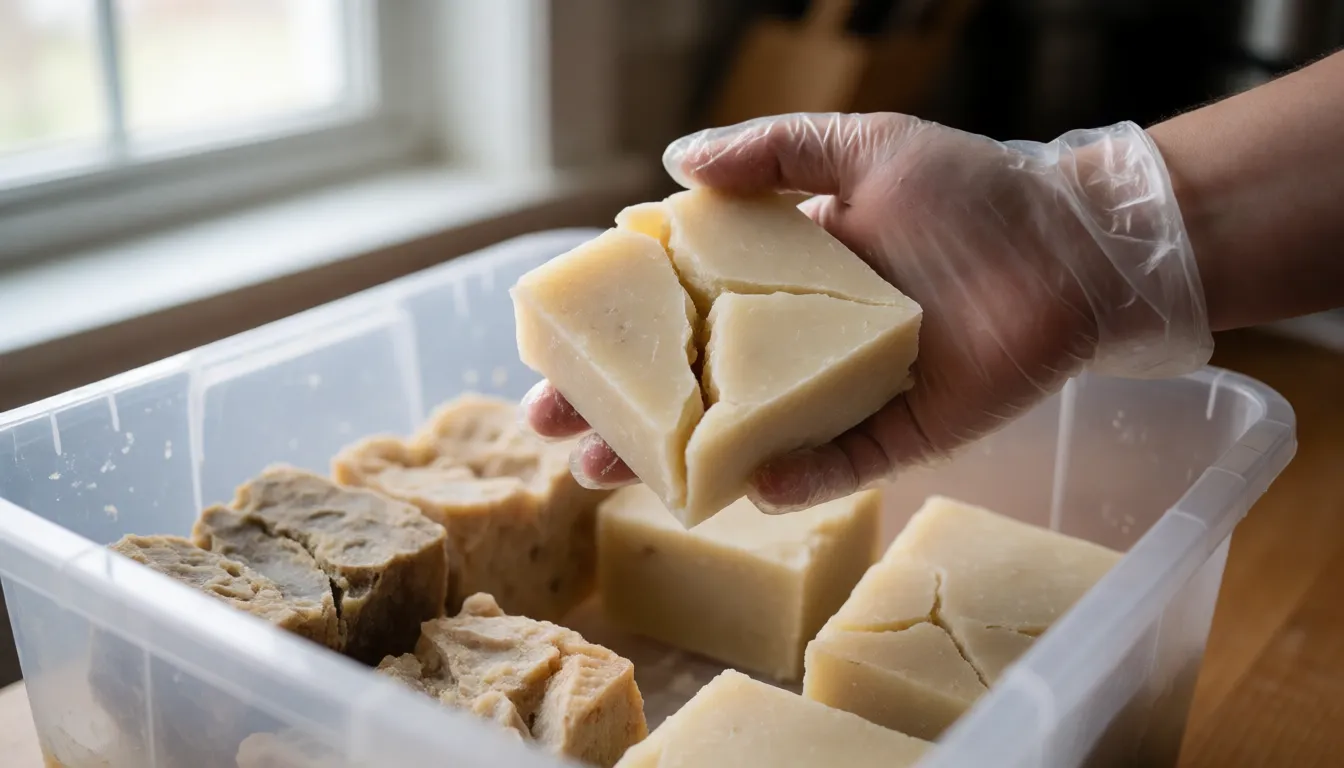
Discard the batch if any of these apply:
- You suspect lye pockets. Rebatching may redistribute the lye, but you cannot confirm it, and a single pocket is enough to cause a chemical burn.
- The error is unknown or unrecoverable. That includes the wrong lye type, or weights that are badly wrong or uncertain. Without real numbers there is no principled oil amount.
- The pH stays high after repeated oil additions. If a batch keeps testing high despite gradual additions, something else is wrong with it.
The reasoning behind the third point is that pH checks are imprecise. If you can't verify a rebatch, the risk to someone's skin outweighs the value of a few bars of soap. A mild case with a known cause is worth fixing, and anything uncertain is not.
Can You Use It for Something Else?
Laundry and cleaning are the uses most often suggested for soap that is a bit too alkaline for skin. Treat this as an option only, and only for soap that is mildly high and evenly mixed. Lye pockets rule it out entirely. If you go ahead, wear gloves and eye protection whenever you grate or dissolve it, and label it clearly so no one mistakes it for skin soap. This is not a promise of safety: a bar that is too harsh for your skin can still irritate hands, and it can affect some fabrics and surfaces. When in doubt, discard.
Disposing of a Bad Batch Safely
Handle a discarded batch like any caustic material, because that is what it may be. Wear gloves and goggles when you break it up or move it. Put it in a sturdy, sealed container or bag, label it, and keep it away from children and pets until it's gone. Check your local household waste rules for how to dispose of it. Wash tools and surfaces that touched the raw batch with plenty of water, and wash your hands afterward.
Finding the Cause and Preventing the Next One
Before you make another batch, work out what went wrong. Go through the list under "What Causes It" in order:
- Compare the oils in your weighing notes with the oils in the calculator.
- Confirm the lye type (NaOH or KOH) was set correctly.
- Check whether you swapped any oil without recalculating.
- Look at the superfat you entered.
- Ask whether anything was measured by volume.
Finding the cause is what keeps the second batch from repeating the first.
The habits that prevent the problem are simple. Run every recipe through the lye calculator, including any version where you changed an oil. Weigh everything on a scale with the container zeroed, and check each number twice. Set a deliberate superfat so a small error doesn't push you past the line. If you want a recipe that has already been calculated, the beginner trinity bar and classic castile soap are good starting points, and what each oil does helps you understand what you are changing before you swap something.
More from the blog
- Lye Safety for Soapmakers: Gear, Airflow, and First Aid
- Lye Burn First Aid: What to Do for Skin, Eyes and More
- Soap Making: Weigh, Not Volume, for Safe Lye Math
- KOH Safety for Liquid Soap: Handling, Paste and Dilution
- How to Zap Test Soap Safely, and What a Zap Means
- What Is Saponification? How Oil and Lye Become Soap
- All posts →