Safety
Soap Making: Weigh, Not Volume, for Safe Lye Math
By The Soap Brain Team — Cold-process soap makers & formulators
·
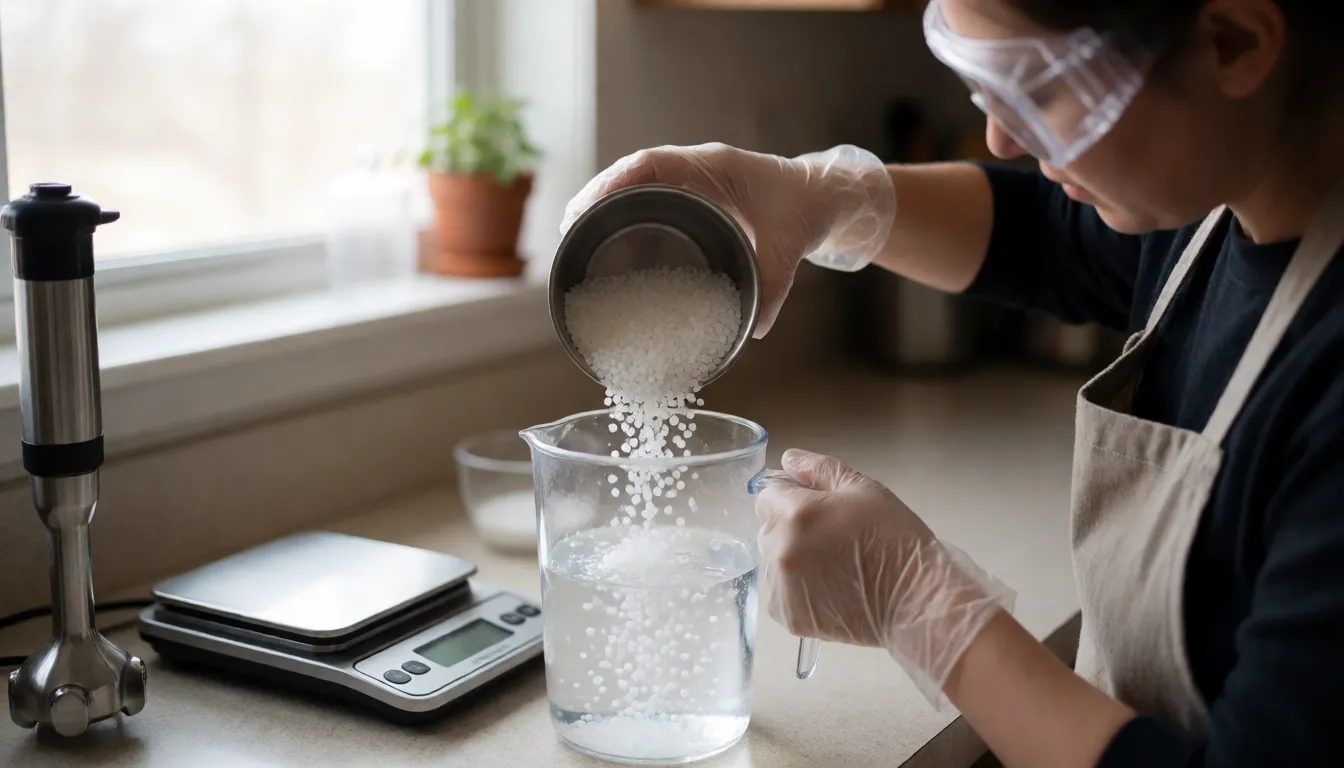
Short answer: no cups, no spoons
No, you can't measure soap ingredients in cups or spoons. Weigh the oils, the lye, the water and the fragrance, and take every number from your lye calculator. The calculator outputs weights, and a cup or spoon can't reliably deliver the weight it was calculated for, because a cup holds a different mass of every ingredient. That gap matters most with lye, where a small error can leave you with a harsh, lye-heavy bar.
Weight vs. volume, defined
Mass is how much matter is in something. Kitchen scales read it, and most people call it "weight," which is how this article uses the word. It's measured in grams or ounces.
Volume is how much space something takes up. Cups, spoons, milliliters and fluid ounces all measure it.
Two things can take up the same space and contain very different amounts of matter. A cup of feathers and a cup of sand have the same volume and very different weights. Soap ingredients differ far less dramatically, but they do differ, and the calculator is unforgiving about it.
Why oils don't share a cup weight
The link between volume and weight is density: mass per unit of volume. Water is the reference point, at about 1 g per mL. Common liquid oils are lighter than water. Olive oil is around 0.91–0.92 g per mL, which is why oil floats on water.
So a cup of water and a cup of olive oil weigh different amounts, and olive oil is the one that comes up short. Other liquid oils also sit below water's density, but each has its own figure. Castor oil, for example, is denser than olive oil, at roughly 0.96 g per mL. The differences between oils are smaller than the gap between oil and water, but they are real, and the calculator works from weights, not cups.
A recipe that says "1 cup olive oil" quietly assumes olive oil's density. That volume gives the intended weight only for olive oil. Use the same "1 cup" for a different oil and you get a different weight than the recipe was built on.
This is also why a volume-based recipe can't be scaled or swapped freely. Change one oil for another and the volume-to-weight relationship changes with it.
Fluid ounces vs. weight ounces
The word "ounce" causes a lot of the trouble, because it names two different things. A fluid ounce measures volume. An ounce (avoirdupois, the kind on a kitchen scale) measures weight. They're only close to each other for water.
One US fluid ounce of water weighs about 29.6 g. One weight ounce is 28.35 g. So a fluid ounce of water overshoots a weight ounce by a little more than a gram, near enough that people treat the two as the same. That habit only holds for water. Oil goes the other way: a US fluid ounce is about 29.57 mL, so a fluid ounce of olive oil at 0.91–0.92 g per mL weighs roughly 27 g, which undershoots a weight ounce.
That matters when a calculator asks for 8 oz of olive oil and you fill a measuring cup to the 8 fl oz line. You've poured about 215–218 g. Eight weight ounces is about 227 g. You're short by roughly 11 g of oil, and nothing on the cup tells you.
Solid fats and air
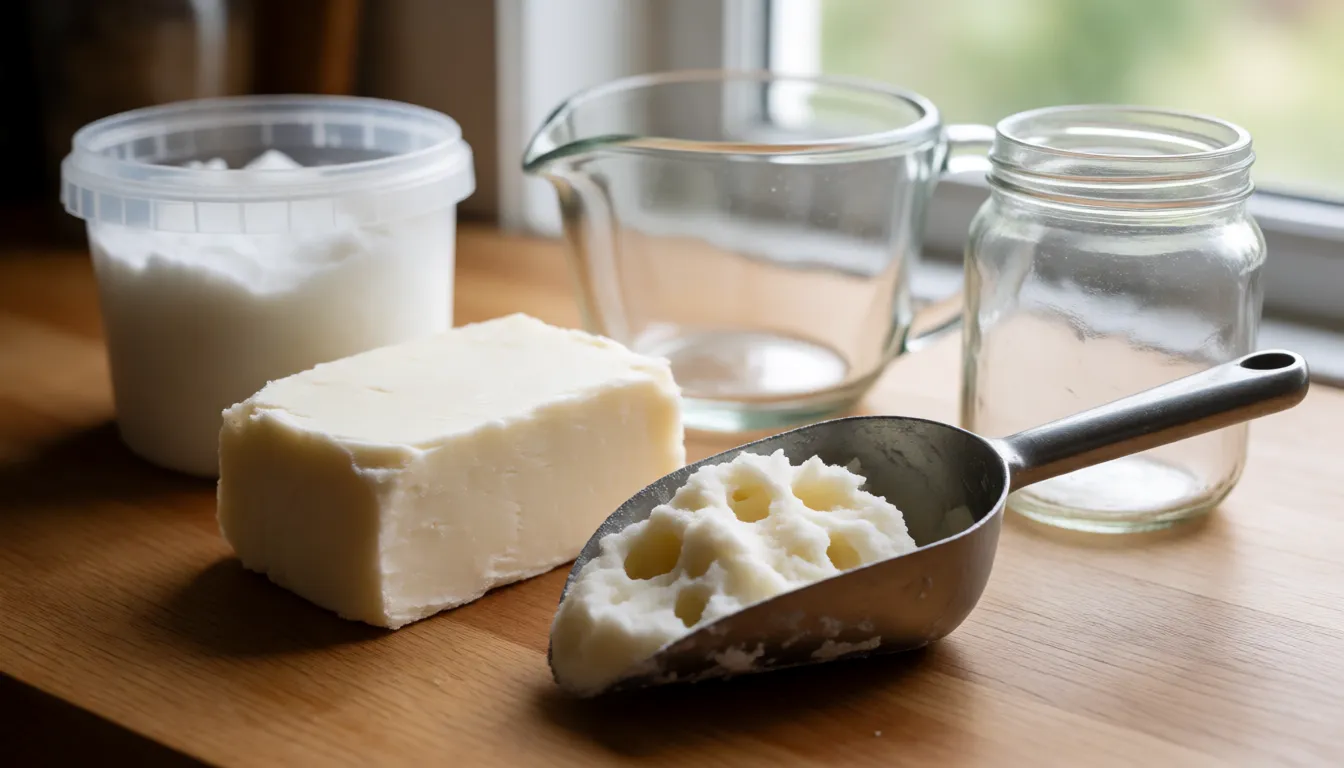
Solid fats add a second problem on top of density. Coconut oil, shea butter and cocoa butter, when scooped into a cup or spoon, trap pockets of air between chunks and against the sides of the measure. Press the scoop down and you get more fat in the cup. Leave it loose and you get less. A heaped cup and a level cup of the same butter are different volumes, and neither is a reliable weight.
Skip the measure altogether. Put the pot on the scale, tare it, and add the fat, melted or solid, until the reading matches the calculator.
Lye: the dangerous one
Lye (sodium hydroxide for bar soap) is sold as beads, flakes or similar forms, and each packs differently. Beads are round and leave gaps between them. Flakes are irregular and pack in another way. The same scoop of each holds a different weight of lye. Lye also absorbs moisture from the air, which changes how it packs and how much a scoop weighs. A volume measure of lye is a guess about mass, and mass is what the chemistry cares about.
Two habits keep the weighing itself clean:
- Weigh lye promptly and keep the supply container closed. A container left open takes on moisture over time, and lye left sitting on a scale gets damp and sticky.
- Never round the lye up "to be safe." It feels cautious, but extra lye means less superfat, meaning less unsaponified oil left in the bar to be gentle on skin. Round the wrong way and you push the bar toward harsh and drying.
The right lye figure depends on your oils and your superfat, so take it from your calculator, in grams or ounces, and weigh exactly that. For a walkthrough of using the calculator without slipping, Making Soap Naturally covers how to use a lye calculator safely.
Safety when you weigh and mix lye
Read this before you weigh any lye. It applies from the first scoop of dry lye through mixing and cleanup.
- Protect yourself. Wear goggles (not just glasses), gloves and long sleeves. Lye burns skin and can blind.
- Use the right container. Weigh and mix lye in stainless steel or heat-safe plastic, never aluminum, which lye corrodes. Keep that container for soap only, not something you cook in.
- Ventilate. Lye mixed with water heats up and gives off fumes. Work near an open window or under a fan, and don't lean over the container.
- Add lye to water, never water to lye. Pouring water onto lye can cause a violent reaction and splashing. Pour the weighed lye slowly into the weighed water, stirring as you go.
- Dry lye spill on a counter or floor: keep it dry. Wearing your gloves and goggles, pick it up with dry paper towel or a dry scoop and dustpan, and put it in a dry container you can close. Then wipe the surface with a damp cloth, rinse the cloth well, and repeat until the surface is clean.
- Lye solution spill: soak it up with paper towels while wearing gloves and goggles, then wipe the area with a damp cloth and rinse the cloth repeatedly. Don't wipe with bare hands or a sponge you use elsewhere.
- Skin splash: if dry lye is on the skin, brush it off first, since water turns it into a caustic solution. Then rinse under running water for at least 15 minutes, removing contaminated clothing while you rinse. Get medical advice if the skin blisters or the burn persists.
- Eye splash: flush the eye continuously with running water for at least 15 minutes, holding the lids open, while someone calls emergency services or poison control (in the US, 1-800-222-1222). Get medical care even if the eye feels better afterward.
Keep children and pets out of the room until the lye is cleaned up and stored.
How a volume error reaches the finished bar
Here is the chain, and a volume error enters at the very first link.
- SAP value. The saponification (SAP) value of an oil is how much lye it takes to turn a given weight of that oil into soap. It's usually given in mg KOH per gram of oil, and calculators convert it for sodium hydroxide. Every oil has its own.
- Lye weight. The calculator multiplies each oil's weight by its SAP value, adds it up, and adjusts for your chosen superfat. That gives the lye for those oils at that weight.
- Superfat. The superfat is the percentage of the oil weight deliberately left without lye to saponify it. With a 5% superfat, the calculator sizes the lye to saponify 95% of the oil and leaves the other 5% as free oil. That free oil is what leaves a bar mild.
- The bar. Whatever ends up in the pot decides whether the superfat you planned is the superfat you get.
Carry the fluid ounce difference through to the calculator. A fluid ounce of water is about 29.6 g, and a fluid ounce of olive oil is about 27 g. Enter "1 oz" for either and the calculator reads it as 28.35 g, so the water is over by a gram or so and the oil is under by about the same margin. Water is forgiving of that. Oil is not, because the lye is sized to the oil.
Now the worked example. Say the calculator wants 8 oz of olive oil by weight, about 227 g, at a 5% superfat. Your lye is weighed correctly from the calculator, and it is sized for the oil weight you entered. You measure 8 fl oz in a cup instead and get about 11 g less oil than planned, which is roughly 5% of 227 g. The lye is still matched to the oil weight you planned for, so it now has almost no spare oil to leave unreacted. The superfat falls from the planned 5% to somewhere near zero. It lands near zero, not past it, but the cushion you planned is mostly gone, and it came from one ingredient measured with the wrong kind of ounce.
Direction matters here. Less oil than planned means lower superfat. From near zero, it takes only a little more error to tip into excess lye: a bigger oil shortfall, a different oil with a different density, or lye measured by scoop, since a scoop can easily hold more than the weight the calculator specified. Once the lye exceeds what the oil can react with, the free lye left in the bar is what makes it harsh, drying and irritating to skin.
The error can run the other way too. Too little lye, or too much oil, leaves excess unsaponified oil in the bar. That gives a soft, greasy bar, and the leftover free oil can go rancid over time. A deliberate superfat is a small, planned amount of unsaponified oil. A volume error produces an unplanned one, of a size you don't know.
Water: more flexible than lye, still weighed
Lye is matched to oil by SAP value. That relationship is fixed, and getting it wrong changes the chemistry of the bar. Water works differently. It dissolves the lye and sets the lye concentration (how much lye is in the lye solution). That in turn influences how fast the batter reaches trace, meaning the point where it thickens enough to hold a trail, and how the bar behaves as it cures.
So a modest change in water is less likely to wreck a batch than a lye error, but that's no reason to be loose with it. Weigh the water figure your lye calculator gives you, or the water figure that comes from the lye concentration you chose in the calculator. A volume measure shifts that concentration by an amount you can't see or repeat. Weigh the water and the batch behaves the way the recipe says it will.
Choosing a scale
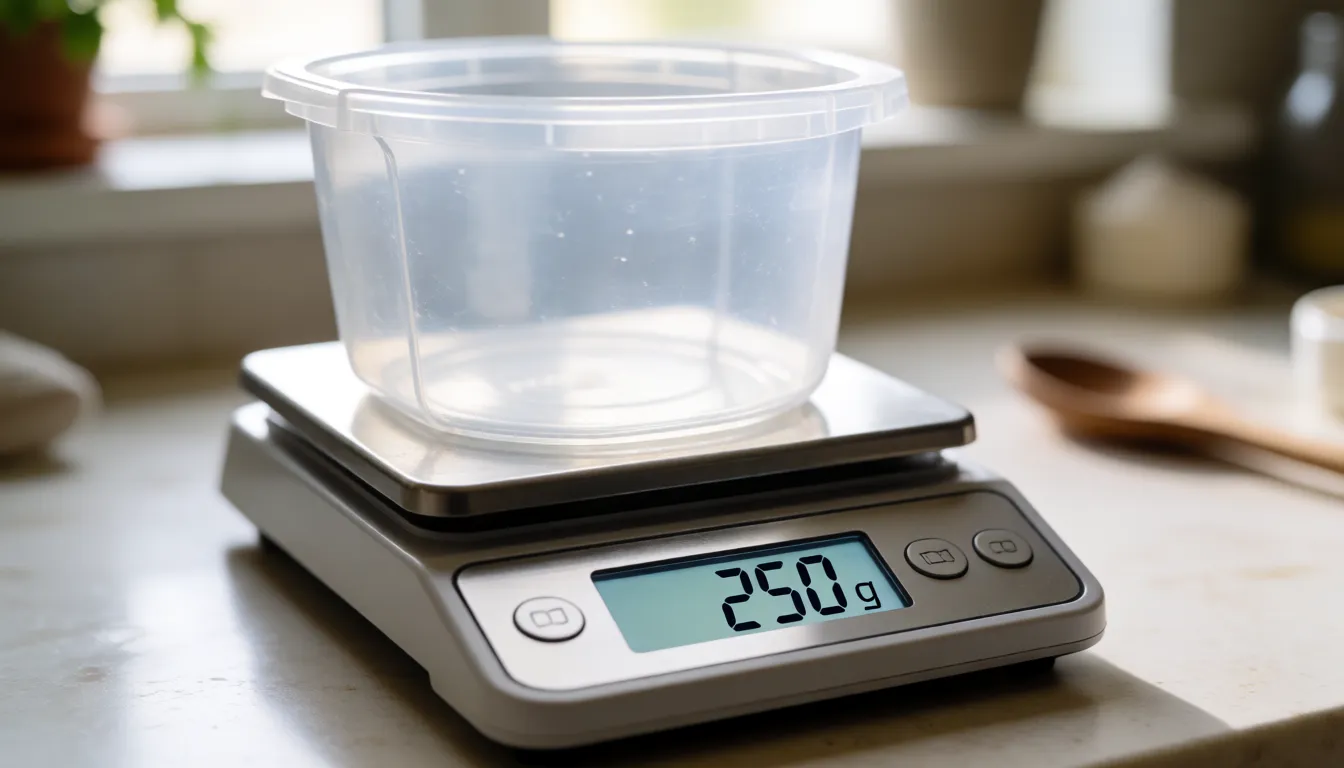
Look for four things:
- Digital. Dial scales drift and are hard to read finely.
- A tare function. Tare zeroes the display with the container on it, so you read only what you added. Without it, you're subtracting container weights in your head.
- Reads to 1 g or better. Finer resolution matters most on the smaller ingredients.
- Enough capacity for the full batch. Check that the maximum weight covers your container plus its contents, not just the ingredient.
A basic kitchen scale suits the bulk ingredients in a batch, but many don't register anything under 1 g, which limits it for small additions. A jewelry scale reads much finer but tops out at a small capacity, too small for a full batch container.
If you have a known weight, check the scale with it. A US nickel is 5 g, for example, so it should read 5 g. If it's off, or the reading wobbles, don't trust it with lye.
Grams vs. ounces
Pick one unit and set your calculator to match. Then use that unit for the entire batch. Don't mix grams and ounces within a batch, because a number read in the wrong unit is an error the scale can't catch for you.
If you need to convert, the figure is 28.35 g per weight ounce. Grams are easier for a few reasons. Recipe percentages convert cleanly to grams, and one gram is a fine increment, where a tenth of an ounce (about 2.8 g) is too coarse for small additions. Most scales offer both units, so setting the scale to grams costs nothing.
Whichever unit you choose, check the calculator's setting before you enter numbers, and again before you weigh.
Weighing in order with tare
The routine is the same for each ingredient:
- Put the empty container on the scale.
- Press tare so the display reads zero.
- Add the ingredient slowly until the display matches the calculator's number.
- Read it once more to confirm.
- Tare again before the next ingredient, or move to a fresh container.
Use a separate container for each of the oils, lye and water, with the lye container chosen as described in the safety section above.
Add slowly near the target, because it's easy to overshoot. If you overshoot with an oil, take a little out with a clean utensil until the display matches.
Lye is different. Don't scoop the excess out by hand-guessing. If you overshoot, use a dry utensil that you keep only for lye, and never return lye to the supply container, since that risks contaminating and dampening the whole supply. If you're not certain of the weight afterward, don't use the portion. Close it in a dry, labeled container, kept out of reach, and weigh a fresh portion from zero.
Small amounts: fragrance and colorant
Fragrance and colorant are small enough to feel like they don't need weighing. They do. A wrong fragrance amount can make a bar irritating to skin or throw off the batch, and a sloppy colorant amount changes the look from one batch to the next.
Fragrance rates differ from oil to oil, so use the supplier's recommended usage rate for that specific oil. Suppliers usually give it as a percentage, and you turn it into grams like this:
rate (as a percentage) ÷ 100 × total oil weight = grams of fragrance
The total oil weight is the combined weight of your oils from the calculator. Do the arithmetic with the supplier's actual rate, weigh the result, and stay at or under it.
Colorant is where a basic kitchen scale can stop being enough. If your scale doesn't register below 1 g, you have two workable options:
- Use a finer scale. A jewelry-type scale that reads finer handles small additions, even though it can't hold a full batch.
- Weigh a larger amount and dilute it. Weigh c grams of colorant, mix it thoroughly into o grams of oil, and note the mixture's total weight, m = c + o. The colorant's share of the mixture is c ÷ m. To get a target of t grams of colorant, weigh out a portion p = t × m ÷ c. That portion contains t grams of colorant and p − t grams of carrier oil. Pick c and o so that p comes out large enough for your scale to read. The carrier oil is part of the batch, so count it toward the recipe's oil weight.
Converting a weight recipe to cups: don't
If you're holding a weight recipe and wondering how to turn it into cups or tablespoons, don't. Every conversion you'd use hides the density and packing problems above, and lye is the ingredient that can least afford them.
Instead, enter your actual oils into the calculator, along with your superfat, and let it give you weights for the oils, lye and water. Then weigh those numbers. If you want to know what each oil does before you choose, the oils guide covers that, and if you'd like a formula that's already worked out, the beginner trinity bar recipe lists its oils and superfat for you to run through the calculator. For a broader explanation of the weight-versus-volume argument, DIY Natural's series on weight and volume is a useful second read.
More from the blog
- Lye Safety for Soapmakers: Gear, Airflow, and First Aid
- Lye Burn First Aid: What to Do for Skin, Eyes and More
- KOH Safety for Liquid Soap: Handling, Paste and Dilution
- How to Zap Test Soap Safely, and What a Zap Means
- Lye Heavy Soap: How to Tell, Fix It or Toss It
- What Is Saponification? How Oil and Lye Become Soap
- All posts →