Guides
Essential Oils for Soap Making: Rates, Picks and Fixes
By The Soap Brain Team — Cold-process soap makers & formulators
·
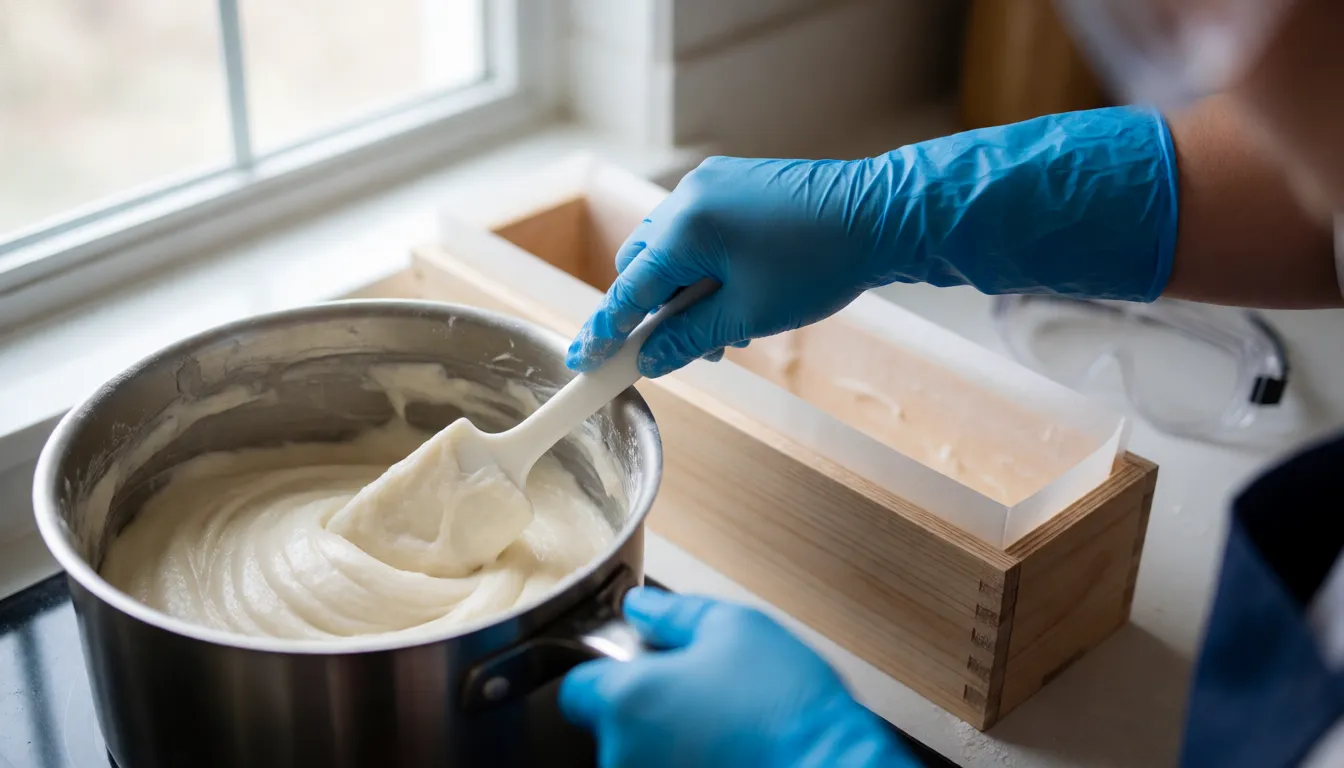
Your soap smelled amazing in the pot and like nothing after cure? Or your batter turned to fudge the second the oil went in? Both are fixable, and both come down to the same short list: use the rate your supplier gives for that specific oil, pick oils that behave in lye, add them at the right moment, and cure with realistic expectations. This article walks through each one and takes on the flash-point rule you've probably seen on a forum.
Why Your Soap Smelled Great in the Pot and Like Nothing After Cure
Lye-heavy batter is a rough place for a delicate scent. Essential oils are volatile, lye chews on some of them, and a four-to-six-week cure gives the rest time to drift off. Meanwhile, a few oils go the other direction and thicken your batter faster than you can pour.
The fix is not "add a lot more." Going over the supplier's limit is how people end up with skin reactions, and it doesn't reliably buy you a stronger bar anyway. The fix is a method, and it starts with the question everyone asks first: how much?
How Much Essential Oil to Use: Find the Rate and Turn It Into Grams
The amount is set by your supplier's recommended usage rate for that exact oil in cold process soap, and you work it out from the total weight of your soaping oils. I'm not handing you a chart, because safe amounts differ from oil to oil. A rate that's fine for one oil can be far too much for another.
Here's the routine:
- Look up the rate. Find the supplier's recommended cold process rate for each specific oil. For a fragrance oil, it's on the IFRA certificate, usually a PDF on the product page: use the Category 9 figure, which is the one that covers soap. Essential oils don't come with a certificate like that, so use the maximum your supplier lists for soap. Do it for every oil in a blend, not just the main one.
- Convert to grams. Total weight of your soaping oils in grams × the supplier's rate as a percentage ÷ 100 = grams of that oil.
- Weigh it in grams. Never spoons. Fragrance is potent, and a "teaspoon" varies wildly between oils.
Here's a worked example with a made-up rate, so don't copy it for any real oil. Say your recipe has 1,000 g of oils and a supplier lists 2% for some oil. That's 1,000 × 2 ÷ 100 = 20 g. Get the oil weight from your recipe, run the oils through the Soap Brain lye calculator for your lye and water, and do the fragrance math separately.
Two things to check on the label:
- Folded citrus (5x, 10x) has its own rate. A 10x orange is not interchangeable with plain orange, so use the rate listed for that exact product.
- Going over a limit can cause rashes and hives, and some oils sensitize more readily than others. Essential oils contain natural allergens such as linalool, citral and coumarin, which is why limits differ. Follow the supplier's guidance and any sensitization warnings, and read the label for anything you or the people using the soap are allergic to.
For a broader look at how makers think about rates, How Much Essential Oil to Add to Soap Recipes + Usage Rates is a handy read alongside your supplier's sheet. Once you know how to size a dose, the next question is what to spend it on.
Essential Oils or Fragrance Oils?
Both can work in cold process, and this article covers both because the same rule applies: use the supplier's recommended rate for that specific product, worked out in grams as above.
The honest comparison:
- Essential oils are plant-derived, more volatile and usually pricier. Some smell faint once they're in soap.
- Fragrance oils sold for cold process are made to survive lye, but they vary from product to product. Some accelerate trace, some discolor (anything with vanilla in it will turn a bar tan to brown), and some hold beautifully. The supplier's notes for that oil are your guide.
If you want a natural-ingredient bar and don't mind a softer scent, go essential. If you want a bar that smells loud at week six, fragrance oils are often the easier route. I use both. Let's start with the essential oils worth your money.
The Best Essential Oils for Cold Process Soap
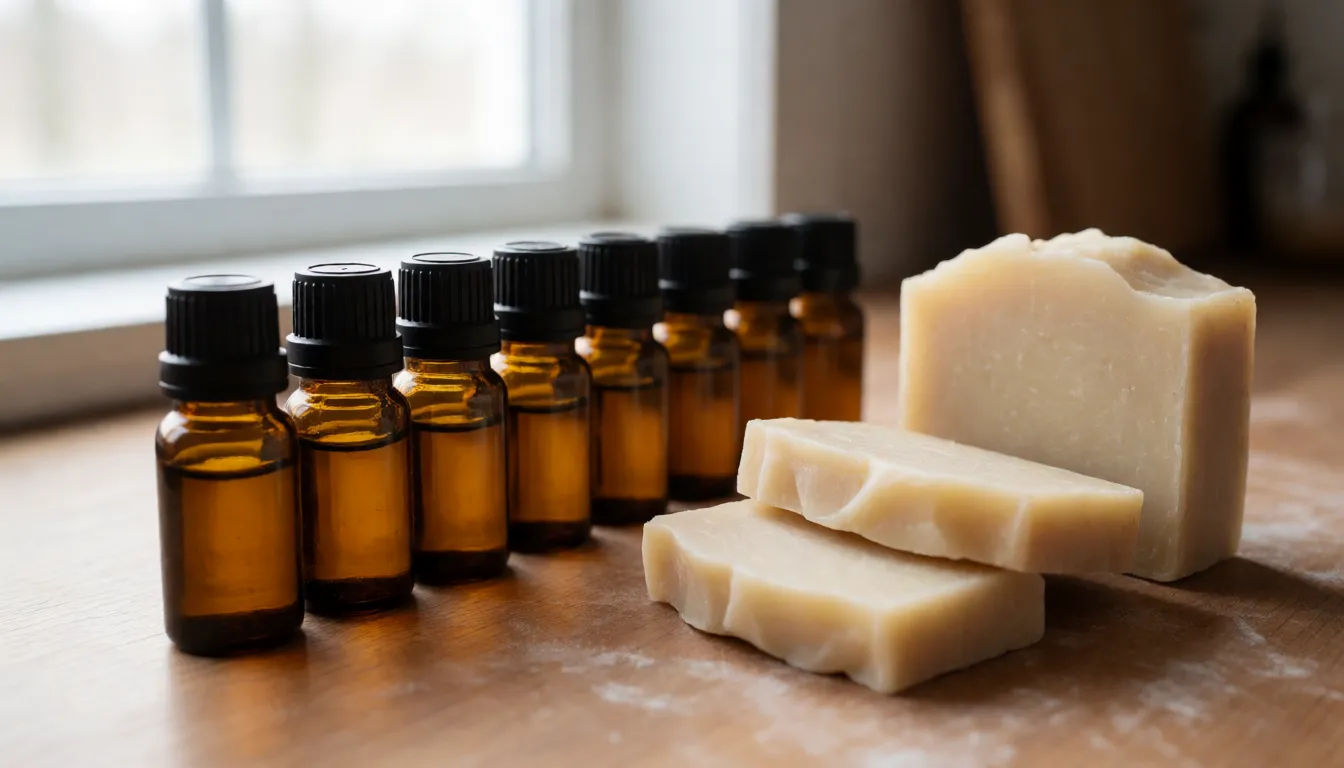
These six behave well in most batches, and none of them is a fussy first-timer trap. Check each one's rate with your supplier as above.
- Lavender: The classic. Soft, herbal and forgiving in the pot, and the oil most people start with.
- Geranium: Rosy and green. It's a good middle note and blends well with almost anything floral or citrus.
- Cedarwood: Dry, woody and warm. It works as a base note and gives blends some backbone.
- Bergamot: Bright, citrusy and slightly floral. It's a top note, so it fades earlier than the rest.
- Grapefruit: Zippy and fresh, and happier in a blend than alone. Like other citrus, it fades, so I'd pair it with a base note.
- May Chang (litsea): Lemony and sweet, and it lasts longer than lemon itself, which makes it a good anchor for a citrus blend.
A sourcing note: sandalwood and some other prized woods raise sustainability questions. If you want that deep, sweet-woody scent, look for responsibly sourced oil, or use an alternative such as cedarwood in a blend. Beyond this shortlist, 30 Essential Oils for Soapmaking + Printable Chart is a good browse for ideas, and Soap making oils and what each one does covers the base oils you're scenting.
Now for the oils that don't play nice.
Oils That Speed Trace (and How to Save the Batch)
Clove and cinnamon are the classic accelerators. They're also strong skin sensitizers with very low safe limits, and cinnamon bark is one many soap makers leave out altogether. Lemongrass and some citrus oils can also thicken batter quickly. These oils tend to have low supplier limits, so look up the rate before you buy, not after.
Set yourself up so the oil can't ambush you:
- Lye calculator setting: I leave the water at a 33% lye concentration, which is the calculator's default, rather than a heavy water discount. Extra water gives you more time before the batter thickens, and the calculator works out the lye and water weights from that setting.
- Soap cool: Aim for roughly 90–100°F (32–38°C).
- Mold ready: Lined, open and within arm's reach before the oil goes in.
- Add early and stir by hand: Add the oil at emulsion or thin trace (see the next section), then stir with a spoon or spatula rather than the stick blender.
I learned this the fudge way. I once added a spicy blend to a batter I'd already taken to a thick trace, then went at it with the stick blender to "mix it in." The pot went from pudding to fudge in about ten seconds, and I was scraping it into the mold like frosting a very stubborn cake. The bar came out lumpy, but it was perfectly good soap, with a top I dressed up with a rough swirl. That kind of texture is an easy save, and 12 Textured Soap Top Ideas for Cold Process Loaves has plenty of ideas.
If your batch thickens fast:
- Stop blending. More blending makes it thicker.
- Spoon or scrape it into the mold. Move quickly and don't wait for it to look perfect.
- Tap the mold on the counter to knock out air pockets, then smooth or texture the top.
- Don't panic. Fast trace is ugly, not ruined. Cut and cure as usual.
For more on this, see Salt Bar Soap Recipe Cold Process: Fix Fast Trace and Cold Process Soap Problems: What's Wrong and How to Fix It. Which brings us to the moment of adding the oil.
Adding Your Oil to the Batter
For most essential oils, add the oil at emulsion or light trace, when the batter has come together but is still thin and pourable. For accelerators, go earlier and gentler: add the oil at emulsion or thin trace and stir it in by hand, as above.
If the oil doesn't blend smoothly, pre-mix it into a small portion of your soaping oils or a scoop of batter first, then stir that back into the pot. This also spreads it evenly, so you don't get a scent-loaded streak.
Lye safety, once and plainly, because this is where you're standing over a pot of lye batter: wear goggles, gloves and long sleeves, work with good ventilation, and always add lye to water, never water to lye. If it splashes on skin, rinse with plenty of running water for at least 15 minutes. If it gets in your eyes, rinse them the same way and get medical help right away. More detail is in Lye Safety for Soapmakers: Gear, Airflow, and First Aid and Lye Burn First Aid: What to Do for Skin, Eyes and More.
Weigh your oil (see the rate section), stir it in, pour and insulate as you normally would. Then comes the waiting, and the part where scent starts to slip away.
Why Scent Fades and What Actually Helps
Three things work against your scent: volatility, lye and time. Essential oils are more volatile than most fragrance oils, so they evaporate more readily. Lye breaks down some of their components. And a four-to-six-week cure gives both of those weeks to do their work.
Ordinary lemon and orange fade fastest. Folded citrus holds better because it's more concentrated and has fewer of the fleeting components. Either way, citrus does best when a base note anchors it (see the next section).
What actually helps:
- Choose sturdier oils or use folded citrus.
- Blend across notes so something holds when the top notes leave.
- Cure for four to six weeks so the bar is mild, but know the scent is strongest early. If scent matters more to you than hardness, start using the bar toward the front of that window rather than the back.
For a deeper look, Essential Oils & Scent Fading is worth a read. Now, how to build something that lasts.
Blends That Last
A blend outlasts a single oil because different oils leave at different speeds. Think of notes in plain terms:
- Top notes are the first thing you smell and the first to go: citrus, some herbs.
- Middle notes are the heart of the scent: lavender, geranium.
- Base notes are slow and heavy, and they anchor everything else.
Start with 25% top, 50% middle and 25% base. The workable range is 20–30% top, 50–70% middle and 20–30% base. Good base-note anchors are patchouli, frankincense and vetiver, and lemongrass or litsea can anchor a citrus blend.
The key point: those proportions describe the blend, not the amount. The blend's total still goes by supplier rates, and every oil in it must stay within its own limit. Here's a made-up example. If your blend total worked out to 20 g, the 25/50/25 split would be 5 g top, 10 g middle and 5 g base. Then check each oil's grams against its own rate. If one is over, shrink the whole blend or swap the oil.
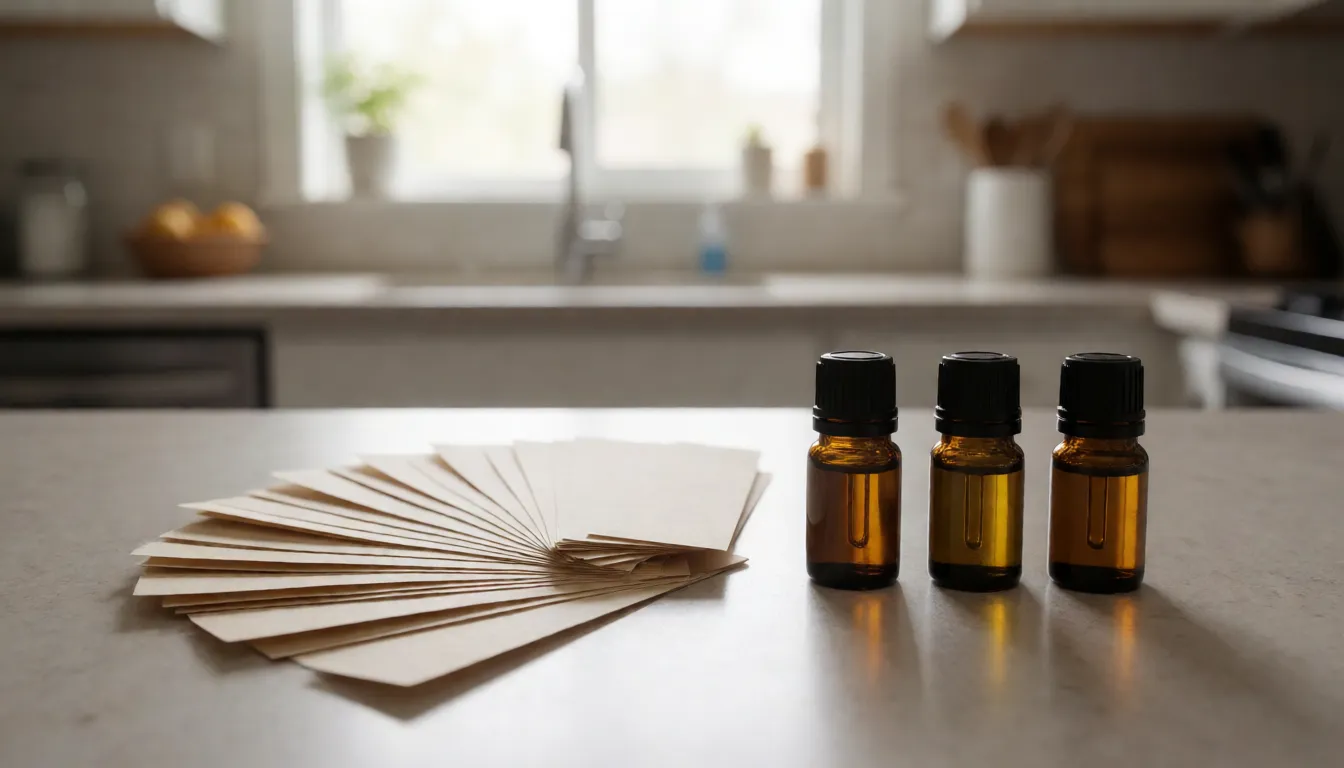
Before committing, do a scent-strip test. Put a drop of each oil on a strip, then a drop of your blend on another, and smell them after a few minutes and again after an hour. For more on building blends, see Natural Oil Blends for Handcrafted Soap Success.
Do Clay and Other Fixatives Help?
Maybe. Makers commonly use clay (kaolin or bentonite), arrowroot and charcoal to help hold scent. One approach is about 1 teaspoon of clay per pound of oils, pre-mixed with the essential oil before it goes into the batter.
I'd treat it as worth a small test batch, not a promise. Clay can change the color and feel of the bar, making it a little duller in color and a little different on the skin. Make a small batch with and without it, and let your nose decide at week four.
Next, a rule that gets repeated far more than it should.
The Flash-Point Myth
You've probably seen it: "Don't use oils with a flash point below your soaping temperature, they'll burn off." It sounds scientific, but it isn't right.
Flash point is the temperature at which an oil's vapor can ignite near a flame. It matters for shipping and storage, and that's about it. It tells you nothing about how fast a scent fades in lye-heavy batter, and there's no open flame in your pot to ignite anything. Your batter at 90–100°F (32–38°C) isn't burning anything off.
What does decide whether an oil survives: its chemistry, how it reacts with lye, and cure time. Two oils with the same flash point can behave completely differently in soap.
A better guide than the number on a chart is to test the oil in a small batch, or trust reports from makers who use it in cold process. That tells you what will happen in your pot.
Your First Scented Batch: What to Do Next
Here's the method in short:
- Find the supplier's cold process rate for each oil, folded citrus included.
- Convert to grams from your total oil weight, and run the recipe through the lye calculator.
- Pick your oils. Start with lavender, geranium or cedarwood before you try an accelerator.
- Add at emulsion or light trace, earlier and by hand for accelerators, soaping cool at 90–100°F (32–38°C).
- Cure four to six weeks, and start using bars toward the front of that window if scent is your priority.
If you don't have a base recipe yet, start with the beginner trinity bar or browse cold process soap recipes. Scent one small batch, jot down what you added in grams, and smell it again at weeks two, four and six. That notebook will teach you more than any chart.
More from the blog
- What Is Saponification? How Oil and Lye Become Soap
- How to Make Liquid Soap: KOH Paste, Dilution, Fixes
- How to Make Breastmilk Soap: Melt and Pour or Cold Process
- Soap pH: What's Normal, Why It's Alkaline, How to Test
- Master Batching Soap: 1:1 Lye Solution and Oil Blends
- Tallow Soap Recipe: A Hard, Long-Lasting Cold Process Bar
- All posts →